Headstones: The Complete Guide to Types, Costs, and How to Choose
Everything you need to know about headstones — types, materials, cost, cemetery rules, and how to order one, explained in plain language.
What is a headstone, exactly?
A headstone is a permanent stone or bronze marker placed at a grave to identify who's buried there — typically with a name, birth and death dates, and sometimes an epitaph, symbol, or portrait. It's set at the head of the grave, which is where the name comes from.
"Headstone," "gravestone," and "tombstone" are used interchangeably in everyday speech, and functionally they mean the same thing. "Grave marker" is the more general industry term, since it also covers flat markers that don't stand upright the way a classic "stone" does. If a cemetery form asks for "marker" instead of "headstone," it's asking about the same category of product.
One distinction worth keeping straight: a monument typically refers to the upright style, while a marker more often means something flat or low-profile. Cemeteries use these terms deliberately, because plenty of sections only allow one or the other.
Types of headstones
Before you fall in love with a design, it's worth knowing what your cemetery section actually allows, since not every style is permitted everywhere.
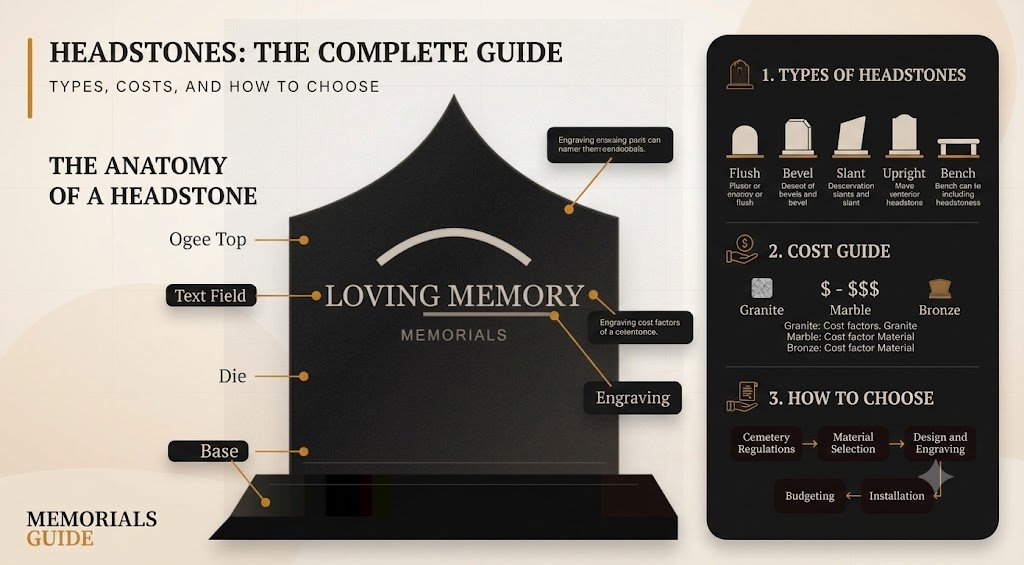
- Upright headstones — the traditional vertical tablet on a base. Most stand 24 to 42 inches tall and offer the most surface area for engraving, photos, and decorative carving.
- Flat (flush) markers — set level with the ground, usually 24×12 inches. Common in sections that need to stay mower-friendly, and generally the least expensive option.
- Bevel markers — like a flat marker, but with a slightly raised, angled front edge. A middle ground that's still low-profile but a bit more visible than fully flush.
- Slant markers — an upright face set at an angle on a base, offering more visibility than a flat marker without the full height of an upright monument.
- Companion and double headstones — a single wider stone or shared base memorializing two people, often couples. Worth planning early, since spacing and layout are harder to adjust after installation.
We cover the tradeoffs between these in more depth — cemetery placement rules, cost differences, and which visibility level each one gives you — in our guides on flat markers vs. upright headstones and companion and double headstones.
Granite, marble, or bronze: which material actually holds up?
Material affects both how the headstone looks in twenty years and what it costs today.
| Material | Durability | Typical cost position | Best suited for |
|---|---|---|---|
| Granite | Excellent — resists weathering, holds polish for decades | Mid-range, best value long-term | Most upright and flat styles; the industry default |
| Marble | Moderate — softens and erodes faster, especially in wet climates | Similar to granite, sometimes higher for fine detail | Traditional or classical aesthetics, drier climates |
| Bronze | Excellent — doesn't crack, ages to a patina | Lower for the plaque itself, but needs a granite base | Flat markers, veteran memorials, modern designs |
Granite is what most cemeteries and monument makers steer families toward for a simple reason: it doesn't erode the way marble does, and it holds fine engraving detail — including sandblasted portraits and laser-etched photos — far longer. Absolute black granite in particular has become the most requested color in North America because of how sharply it contrasts against light-colored lettering.
Marble looks beautiful when it's new, but it's a softer stone, and inscriptions can start to soften within a few decades in humid or freeze-thaw climates. Bronze plaques are extremely durable but are almost always mounted on a granite base rather than standing alone, which adds a step to the order.
For a full side-by-side including maintenance and appearance over time, see our granite vs. marble vs. bronze comparison.
How much does a headstone cost?
Prices vary widely — from around $200 for a simple flat marker to $5,000 or more for a large upright monument with detailed engraving. A few factors drive most of that range:
- Size and weight. Headstones are often priced partly by weight, so a larger stone costs more before you've added a single letter.
- Material. Granite and marble sit in a similar range; bronze markers can be less expensive for the plaque itself, but usually require a separate granite base.
- Engraving complexity. A name and two dates costs far less than a sandblasted portrait, custom motif, or laser-etched photo.
- Foundation and installation. Cemeteries typically charge a separate setting fee, and it's worth asking upfront — even if you buy the stone elsewhere, most cemeteries can (and often do) charge to install it.
- Where you buy it. Cemetery gift shops, local monument dealers, and factory-direct manufacturers all price differently, largely based on how many hands the stone passes through before it reaches you.
That last point is where factory-direct sourcing actually changes the number. Buying straight from the manufacturer, the way we do at Marwaa, cuts out the dealer markup layer entirely — you're paying for the stone and the craftsmanship, not a chain of resellers. Our full headstone cost breakdown walks through real numbers for Canada and the USA.
Cemetery rules you need to check before you order
Here's the part most people find out about the hard way: cemeteries set their own rules on headstone size, material, and style, and those rules vary not just by cemetery but sometimes by section within the same cemetery. Some plots only accept flat markers. Some require a specific foundation depth. Some won't allow certain colors of granite.
By law, a cemetery generally can't refuse a headstone you bought elsewhere as long as it meets their written specifications — but they can charge a setting fee for installing it, and many require paperwork (an authorization form, a permit, sometimes a photo-release waiver) before delivery. Get the cemetery's rules in writing before you finalize a design, not after.
Our cemetery headstone rules guide breaks down what to ask for across Canada and the USA, including foundations, vases, and permit paperwork.
Designing and engraving a headstone
Beyond the name and dates, most families personalize with an epitaph, a religious or cultural symbol, a decorative motif, or a photo of the person. Sandblasted lettering, CNC-carved artwork, and laser-etched portraits are the three most common techniques, and each gives a different look and price point.
This is also where cemetery rules resurface — some sections restrict emblem types, portrait sizes, or engraving depth, so it's worth confirming before you lock in a design rather than after a proof is made. For a full walkthrough of fonts, layout, symbols, and proofing, see our custom headstone engraving guide.
Free headstones for veterans
This is the one almost nobody brings up until it's too late to use: the U.S. Department of Veterans Affairs will furnish a headstone, marker, or medallion at no cost for an eligible veteran's grave, including for veterans buried in private cemeteries with an otherwise unmarked grave. If a veteran already has a privately purchased headstone, VA can instead provide a bronze medallion to affix to it, recognizing their service.
Eligibility depends on service dates and discharge status, and the application goes through VA Form 40-1330 (headstone or marker) or 40-1330M (medallion) — details worth confirming directly with the National Cemetery Administration before you assume either way, since the rules are specific to date of death and cemetery type.
How long does it actually take?
From approving a design to a headstone sitting in the cemetery, most families are surprised the process isn't fast — quarrying, cutting, engraving, and shipping all take real time, and international or cross-border orders add customs and freight on top of production. Planning for several weeks to a few months, rather than assuming it happens in days, avoids a lot of frustration.
We break down realistic timelines stage by stage — including why most experienced monument dealers actually recommend waiting a few months after a burial before ordering, so the ground can settle before installation — in our production and lead times guide. If you're planning a headstone in advance rather than after a loss, our pre-need planning guide covers what to lock in now versus later.
Where to buy a headstone
Families generally have three routes: the cemetery's own gift shop, a local monument dealer or stonemason, or a factory-direct manufacturer.
Cemetery shops are convenient but often the most expensive, since you're paying for one vendor's exclusive access. Local dealers let you see and touch sample stones in person and usually know your specific cemetery's rules well — genuinely useful if you want a face-to-face conversation during a difficult time. Factory-direct manufacturers cut out the markup layers in between, which is where the biggest cost difference shows up, though it means doing more of the design process remotely.
That's the gap we built our Design Studio to close — you can choose the monument shape, granite color, and inscription layout with a live preview before requesting pricing, so you're not designing blind just because you're not standing in a showroom. When you're ready, request a quote and our team will walk through cemetery requirements, timelines, and delivery with you directly.
Key Takeaways
- A headstone, gravestone, and tombstone all mean the same thing; "grave marker" is the broader industry term that also covers flat and flush styles.
- Granite is the most durable and widely used material, with marble softening faster in wet climates and bronze plaques typically needing a granite base.
- Headstone prices commonly range from around $200 for a simple flat marker to $5,000+ for a detailed upright monument, with size, material, engraving, and installation fees all factoring in.
- Every cemetery sets its own rules on size, material, and style — get them in writing before finalizing a design, since rules can vary by section within the same cemetery.
- Eligible U.S. veterans can receive a government-furnished headstone, marker, or medallion at no cost through the VA.
- Buying factory-direct, rather than through a dealer chain, is where most of the real cost savings show up without sacrificing material quality.
Next Step
Ready to see your options? Explore our full headstone collection or start designing in our Design Studio — it takes a few minutes and gets you a factory-ready brief before you ever request pricing.
Frequently Asked Questions
What is the difference between a headstone and a gravestone?
None, functionally — the terms are used interchangeably to describe the marker placed at a grave. "Grave marker" is the broader term that also includes flat and flush styles that don't stand upright.
What's the typical cost of a headstone?
Most range from around $200 for a simple flat marker to $5,000 or more for a large upright monument, depending on size, material, and engraving complexity.
What is a headstone?
A permanent stone or bronze marker placed at the head of a grave, typically showing the name, birth and death dates, and sometimes an epitaph, symbol, or portrait.
Which type of headstone lasts the longest?
Granite is generally the most durable choice — it resists weathering and holds engraving detail far longer than marble, which can soften and erode over decades, especially in humid or freeze-thaw climates.
Can a cemetery refuse a headstone I bought elsewhere?
Generally not, as long as it meets the cemetery's written specifications — but they can charge a separate setting or installation fee, and may require permits or authorization forms before delivery.
Ready to get pricing for your granite monument?
Request pricing, factory specifications, and DAP delivery timelines from our team.