Granite vs. Marble vs. Bronze: Which Material Is Right for a Memorial?
Comparing granite, marble, and bronze for headstones and monuments — durability, cost, maintenance, and which one fits your needs.
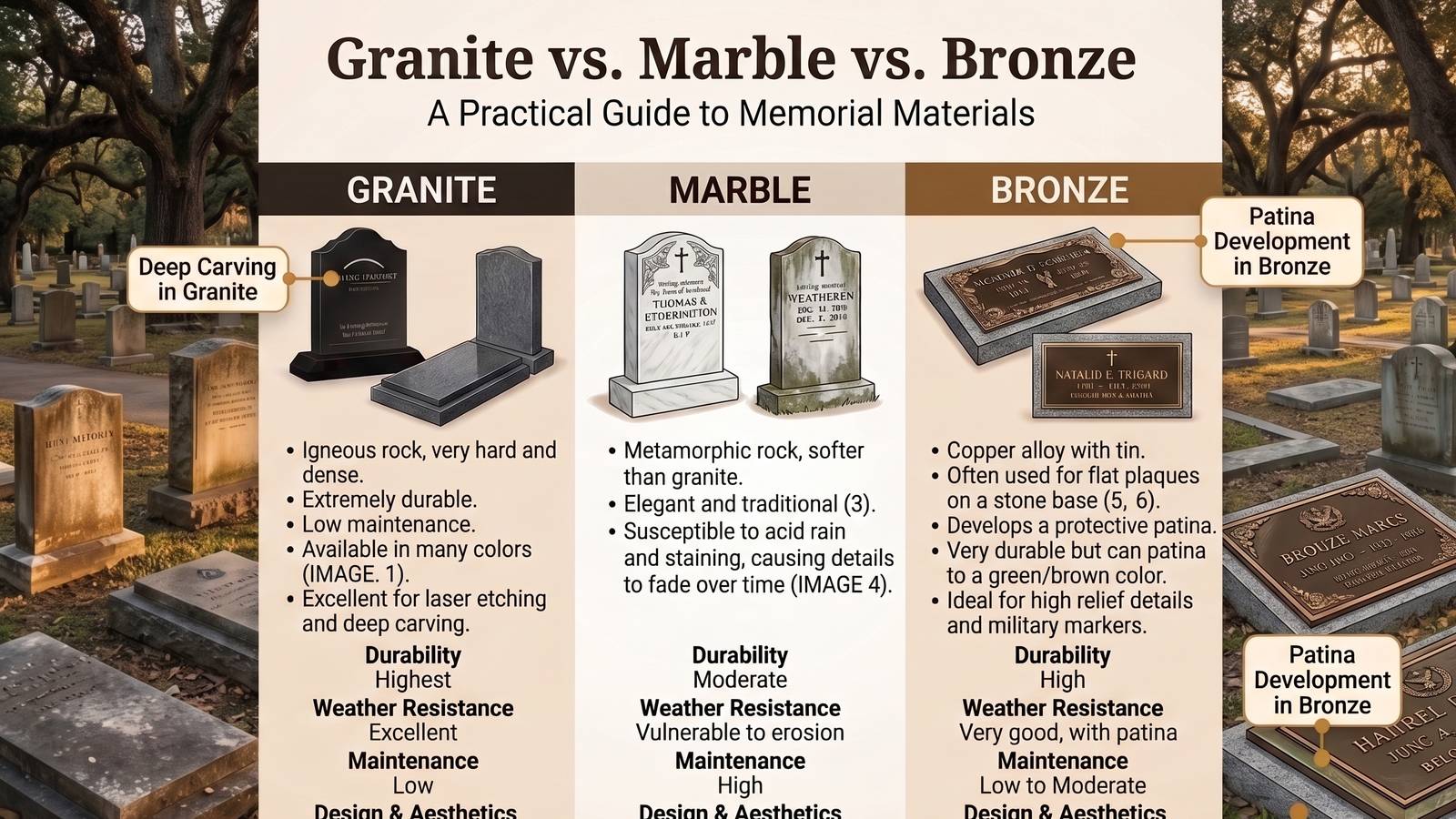
Walk through any older cemetery and you'll see the story written in stone: crisp granite markers from the last few decades standing next to century-old marble that's gone soft and hard to read, with the occasional bronze plaque holding its ground somewhere in between. That contrast isn't random — it's the material speaking for itself, decades after anyone chose it.
If you're choosing a memorial material today, here's how the three main options actually compare.
The short answer
Granite is the most durable and lowest-maintenance of the three, and it's why the overwhelming majority of memorials made today use it. Marble is more porous and weathers faster outdoors, but its soft, luminous look still appeals to people who value appearance over multi-century longevity. Bronze sits in between on durability and is most often used for flat markers or as decorative plaques mounted on a granite base, rather than as a full standalone headstone.
None of the three is objectively "wrong" — the right choice depends on what you're weighing: how long you need the inscription to stay sharp, your budget, your cemetery's rules, and the look you actually want standing over the grave.
Granite
What it is: An igneous rock formed from cooled magma under enormous heat and pressure, which is exactly why it holds up the way it does.
Durability: Granite is the densest and least porous of the three materials, and it shows. High-quality granite deteriorates on the scale of a fraction of a millimeter over centuries, meaning an inscription cut today will likely still be legible for your great-great-grandchildren.
Appearance: Granite comes in a genuinely wide color range — black, gray, blue, green, brown, red, and more — depending on the mineral composition and where it's quarried. It can be finished to a mirror-like polish or left in a more matte, natural texture.
Engraving: Granite takes laser etching exceptionally well, which is why detailed portraits and fine linework hold their sharpness outdoors for generations. See our black granite monuments guide for what's possible on a dark, high-contrast finish specifically.
Maintenance: Low. Occasional cleaning with a soft cloth and a stone-safe cleaner is typically all it needs — no regular sealing required. Our care and maintenance guide covers the specifics.
Cost: Mid-range to premium depending on color rarity and design complexity, but its longevity often makes it the most cost-effective option over a multi-generation timeframe. See our monument cost guide for a fuller breakdown.
Marble
What it is: A metamorphic rock formed when limestone is transformed by heat and pressure. Softer and more workable than granite, which is exactly why it was the dominant memorial material for centuries before modern quarrying and cutting technology made granite practical at scale.
Durability: This is where marble's story gets complicated. Its calcium carbonate composition reacts with acid rain and atmospheric pollutants, and its higher porosity lets moisture into the stone through repeated freeze-thaw cycles. Over enough decades, this shows up as eroded surface detail and inscriptions that fade toward illegibility — which is exactly what you're seeing on those soft, weathered markers in older cemetery sections.
Appearance: Marble's smooth texture and natural veining give it a genuinely distinctive, elegant look that granite doesn't replicate. White and gray are the most common and most weather-appropriate shades; more exotic colors exist but are rarer and less suited to long-term outdoor exposure.
Engraving: Marble carves beautifully and takes fine detail well when it's new — it's part of why it was favored for sculptural work for so long. The tradeoff is that fine detail is also the first thing lost to weathering over time.
Maintenance: Meaningfully higher than granite. Marble benefits from more frequent cleaning and periodic sealing (roughly every one to two years) to slow staining and surface erosion.
Cost: Often comparable to or higher than standard granite, depending on the specific stone and finish, without granite's long-term durability advantage.
Bronze
What it is: A cast metal alloy, not a natural stone, most often paired with a granite base rather than used entirely on its own.
Durability: Strong. Bronze resists cracking and chipping in ways stone can't, and it holds up well across most climates, including coastal areas where stone can be more vulnerable to salt exposure.
Appearance: Bronze develops a natural patina over time — a gradual color shift that most people read as a dignified sign of age rather than a flaw. It can also be polished back to a brighter finish if a family prefers that look.
Engraving: Bronze's casting process makes it especially good for raised lettering, plaques, and intricate cast designs like florals or religious imagery, in a way flat engraving on stone doesn't quite replicate.
Maintenance: Low to moderate. Occasional cleaning keeps it legible, and periodic polishing is optional depending on whether a family wants to preserve the brighter original finish or let the patina develop naturally.
Cost: Generally on the higher end, particularly for larger or more custom cast pieces, due to the casting process itself.
A quick side-by-side
| Granite | Marble | Bronze | |
|---|---|---|---|
| Durability | Excellent | Moderate (weathers over decades) | Strong |
| Maintenance | Low | Higher (periodic sealing) | Low–moderate |
| Color range | Wide | Narrower (mainly white/gray outdoors) | Brown, develops patina |
| Best for | Full monuments, upright or flat | Indoor/sheltered memorials, traditional aesthetic | Flat markers, plaques, combined with granite |
| Typical cost | Mid–premium | Mid–premium | Premium |
Does your cemetery even allow all three?
This is worth checking before you fall in love with a material. Many cemeteries restrict certain materials to specific sections — flat-marker sections, for instance, sometimes require bronze or low-profile granite rather than upright stone. Our cemetery rules and regulations guide walks through how to confirm this before you commit to a design.
Can materials be combined?
Yes, and it's more common than people expect. A bronze plaque mounted on a granite base is one of the most traditional combinations in the industry — it gets bronze's detailed casting on the plaque itself while granite handles the structural, weather-facing base. Some families also use granite for the main headstone with a smaller marble or bronze accent element, though it's worth confirming your cemetery permits mixed-material designs before finalizing anything.
Key Takeaways
- Granite is the most durable and lowest-maintenance choice, and it's why it dominates modern memorial design.
- Marble's soft, elegant look comes with a real durability tradeoff — expect more visible weathering and fading detail over multi-decade timeframes, especially outdoors.
- Bronze is strong and low-maintenance but is most commonly used for flat markers or plaques rather than full upright monuments.
- Combining materials (like a bronze plaque on a granite base) is a well-established option, not an unusual request.
- Check your cemetery's material rules before finalizing a design — some sections restrict which materials are allowed.
Next Step
If you're weighing materials for a memorial project, our design studio lets you compare granite colors and finishes directly, and our team can walk you through samples and pricing when you request a quote.
Frequently Asked Questions
Which is better for headstones, granite or marble?
Granite is generally the more durable and lower-maintenance choice for outdoor memorials, though marble remains popular for its distinctive appearance, especially in sheltered settings.
Does bronze rust or corrode?
Bronze doesn't rust the way iron does. It develops a natural patina over time, which is a surface color change rather than structural corrosion, and it can be polished if a brighter finish is preferred.
What's the most durable headstone material?
Granite is widely considered the most durable option for long-term outdoor use, deteriorating only fractions of a millimeter over centuries under typical conditions.
Why do so many old cemeteries have marble headstones that are hard to read?
Marble was the dominant memorial material for much of the 18th and 19th centuries. Its higher porosity and reaction to acid rain mean inscriptions from that era have often eroded more than granite markers from the same period would have.
Can granite and bronze be combined on one memorial?
Yes — a bronze plaque set into a granite base is one of the most established combinations in the industry, pairing bronze's detailed casting with granite's long-term durability.
Ready to get pricing for your granite monument?
Request pricing, factory specifications, and DAP delivery timelines from our team.