Headstones for Graves: Types, Costs, and Cemetery Rules
A complete guide to headstones for graves: types, materials, average costs, and cemetery rules, from a factory-direct granite exporter.
Key Takeaways
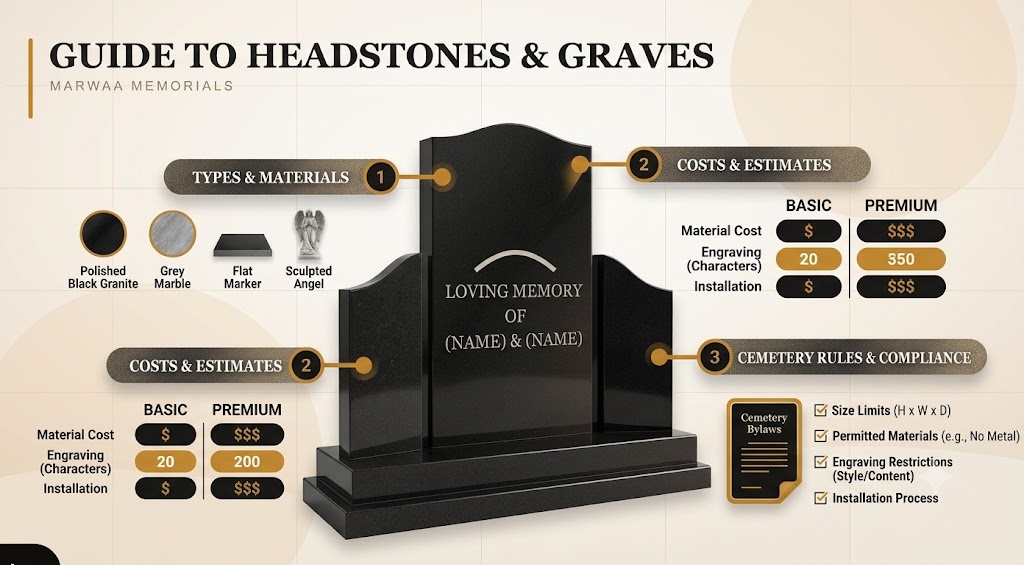
- Headstones for graves fall into a handful of core types: upright monuments, flat markers, slant and bevel markers, bronze markers, and companion or family memorials.
- Granite is the most common modern headstone material because of its durability and resistance to weathering, though bronze and marble remain common choices for specific cemetery sections.
- Every cemetery sets its own rules on size, material, and placement, so confirming those rules comes before choosing a style, not after.
- Total headstone cost includes more than the stone itself: engraving, foundation work, cemetery fees, and installation typically add several hundred dollars beyond the base price.
- Eligible US veterans can receive a government-furnished headstone or marker at no charge through the Department of Veterans Affairs, though private cemeteries still set their own placement rules.
What Counts as a Headstone for a Grave
A headstone is a permanent marker placed at a grave to record a name, dates, and, usually, a short inscription. The term gets used loosely. Some people mean specifically an upright stone at the head of the grave, while others use "headstone" and "grave marker" interchangeably to cover anything from a flat plaque to a full family monument.
That looseness matters when you're searching for pricing or cemetery rules, because a cemetery's regulations often draw a hard line between upright monuments and flat markers, and treat them as entirely different categories of memorial.
Types of Headstones for Graves
Most cemeteries fall into two broad categories: sections that allow upright monuments, and lawn or memorial-park sections that require flat, ground-level markers for easier mowing and maintenance. Which type is even an option for a specific grave usually depends on the cemetery section, not personal preference.
Upright headstones
An upright headstone stands vertically on a base, usually granite. It's the style most people picture when they hear the word "headstone." Upright stones offer the most surface area for names, dates, an epitaph, and any symbols or artwork the family wants included.
Flat grave markers
A flat marker sits level with the ground, made from granite, bronze, or bronze mounted on a granite base. Flat markers are standard in memorial parks and lawn cemeteries, and they cost noticeably less than upright monuments because they use less material and require less labor to set.
Slant and bevel markers
A slant marker angles upward from a lower back edge, giving better readability than a flat marker while staying shorter than an upright monument. A bevel marker (sometimes called a pillow marker) sits low with a slightly raised, sloped face. Both work well in cemeteries that allow raised memorials but not full upright stones.
Bronze markers
A bronze marker is a cast plaque, typically mounted on a granite base, common in memorial parks and at many national and veterans' cemeteries. Bronze develops a natural patina over years outdoors, which some families like and others maintain against with periodic cleaning.
Companion and family memorials
A companion headstone marks two graves, usually spouses, on one shared stone. If one spouse is still living, the layout needs to leave room for the second death date without looking unbalanced in the meantime. A family monument marks a larger plot, often with a central surname stone and smaller individual markers around it.
Headstone types compared
| Type | Typical setting | Starting cost range* | Main tradeoff |
|---|---|---|---|
| Flat granite marker | Memorial parks, lawn cemeteries | $500-$1,200 | Less visible, least expensive |
| Bronze flat marker | Memorial parks, veterans' cemeteries | $800-$2,500 | Patinas over time |
| Slant/bevel marker | Traditional and lawn cemeteries | $1,000-$2,000 | Limited design space |
| Upright granite headstone | Traditional cemetery sections | $1,500-$4,000 | Not permitted everywhere |
| Companion headstone | Shared plots | $3,000-$6,000 | Must reserve space for future dates |
*Ranges reflect the stone and basic engraving only. Cemetery fees, foundation, and installation are added separately in most cases; see the cost breakdown below.
Materials: Granite, Bronze, and Marble
Granite is the leading material for new headstones because it holds up to decades of outdoor weather with very little maintenance and takes engraving, sandblasting, and laser etching cleanly. It comes in a wide color range, from traditional gray to black, red, blue, and mahogany, and black granite in particular gives the strongest contrast for laser-etched portraits.
Bronze is the standard for flat memorial-park markers and is often required, rather than optional, in cemetery sections that specify it. It allows raised lettering and detailed emblems that granite engraving can't quite match.
Marble has a softer, more traditional look and was the standard choice for generations, but it's more porous than granite and weathers faster, so inscriptions on older marble stones often soften over time. Most memorial providers, including us, now recommend granite for new orders specifically because it holds detail longer.
One thing worth knowing if you're comparing prices: a lot of the cost difference you'll see between an online listing and a local monument dealer's quote for the same size and finish of granite headstone comes down to how many hands the stone passes through before it reaches a cemetery. A stone cut and finished at the factory and shipped factory-direct to a dealer skips a layer of import markup that a stone bought and resold through multiple distributors carries. That's not a reason to distrust a low online price, but it is a reason to ask exactly what's included before comparing two numbers side by side.
Cemetery Rules Come First
Every cemetery sets its own rules on headstone size, material, color, and placement, and sometimes different sections within the same cemetery have different rules. One section might allow upright granite monuments up to four feet tall; the section next to it might require flat markers only.
There's no rush to figure this out. Most families take their time on the decision, and cemeteries generally don't require a marker to be installed within any strict window after burial.
Before ordering anything, it's worth getting the cemetery's written rules on:
- Whether upright, flat, or bronze markers are permitted in that section
- Maximum height, width, and base dimensions
- Approved granite colors or finishes
- Foundation requirements and who's responsible for them
- Vase, footstone, and installation procedures
- Permit, inspection, or setting fees
A cemetery can and does reject a design that doesn't meet its rules, even after a family has already paid for it, which is why this step comes before choosing a style rather than after.
Veteran and military markers
Eligible US veterans can receive a government-furnished headstone or marker from the Department of Veterans Affairs at no charge, for an unmarked grave regardless of date of death, or for a grave already marked with a private headstone if the veteran died on or after November 1, 1990. Spouses and dependents generally aren't eligible for a government-furnished marker unless they're buried in a national cemetery, state veterans' cemetery, or military post or base cemetery. Upright headstones in granite or marble, flat markers in granite, marble, or bronze, and bronze niche markers are all available options, but the private cemetery where the marker will be placed still decides which of those styles it permits.
What Headstones for Graves Actually Cost
Headstone pricing rarely comes as one clean number, and that's the single biggest source of confusion we hear on quote calls. The base stone price and the total out-of-pocket cost are usually two different figures.
| Cost component | Typical range | Notes |
|---|---|---|
| Flat granite marker | $500-$1,200 | Base stone plus basic engraving |
| Upright granite headstone | $1,500-$4,000 | Wide range depending on size and detail |
| Bronze marker on granite base | $800-$2,500 | Bronze plaques cost more than granite alone |
| Engraving (name, dates) | Often included; extra wording adds cost | Photo etching adds the most |
| Foundation | $200-$800 | Some cemeteries require a specific foundation type |
| Installation/setting | $200-$2,000 | Varies by size and cemetery labor rates |
| Cemetery permit/setting fee | Varies by cemetery | Confirm directly; not standardized |
A note for dealers and funeral homes: the spread in the table above is exactly where factory-direct sourcing changes your margin. A granite headstone blank purchased through a domestic distributor typically carries two or three markups before it reaches a monument dealer's shop; sourcing the same size and finish factory-direct removes at least one of those layers, which either protects margin or lets a dealer quote more competitively on the exact same stone.
Ordering a Headstone: Basic Steps
- Confirm the cemetery's rules for the specific plot, in writing if possible.
- Choose the type and material that fits what's allowed and what the family wants.
- Decide the inscription and any symbols, keeping wording concise since long text reduces readability.
- Review a proof carefully before production begins; changes after carving or casting are difficult or impossible.
- Confirm installation details, including who handles delivery, foundation, and setting, and what the cemetery charges separately.
Next Step
If you're a dealer or supplier evaluating where your granite headstones come from, our Request a Quote page is the fastest way to get factory-direct pricing on the sizes and colors covered above.
Cemetery rules on monument size, material, and installation vary by individual cemetery, and sometimes change without much notice. The rules described above, including the veteran and military marker eligibility criteria, reflect common patterns and the current cem.va.gov guidance at the time of writing, not a universal standard. Before finalizing an order, confirm the specific requirements with the cemetery office directly. For US veterans' cemeteries, the Department of Veterans Affairs publishes current, authoritative specifications.
Frequently Asked Questions
How much does a headstone for a grave cost?
A basic flat granite marker typically runs $500 to $1,200, while an upright granite headstone starts around $1,500 and can run several thousand dollars depending on size, granite color, and design complexity. Foundation, engraving beyond a name and dates, and cemetery installation fees are usually separate from the base stone price.
Can I put a headstone on a grave myself?
In most cases, no. Headstones are heavy, and nearly every cemetery requires installation by an approved installer for safety and liability reasons. Some cemeteries will install a marker you purchased elsewhere for a separate setting fee, but the cemetery's own rules decide who's allowed to do the physical installation.
What are the best headstones for graves?
There's no single "best" headstone; the right choice depends on what the specific cemetery section allows, the material's durability in the local climate, and the family's budget. Granite is generally the most durable and lowest-maintenance modern material, and upright monuments offer the most design space where cemeteries permit them.
What is the average cost of a cemetery headstone?
Averages vary widely by region and cemetery, but a reasonable planning range is $500 to $1,500 for a flat marker and $1,500 to $4,000 for an upright granite headstone, before foundation, engraving extras, and installation fees.
Do all cemeteries allow the same types of headstones?
No. Cemetery sections often specify flat markers only, upright monuments only, or a specific material and color, and the rules can differ section to section within the same cemetery. Always confirm before ordering.
Ready to get pricing for your granite monument?
Request pricing, factory specifications, and DAP delivery timelines from our team.