Transcribing a Worn Headstone Without Guessing
Record uncertain gravestone text honestly, preserve line breaks and separate visible letters from later family-history interpretations.
By Marwaa Team · Editorial standards · Published · Updated

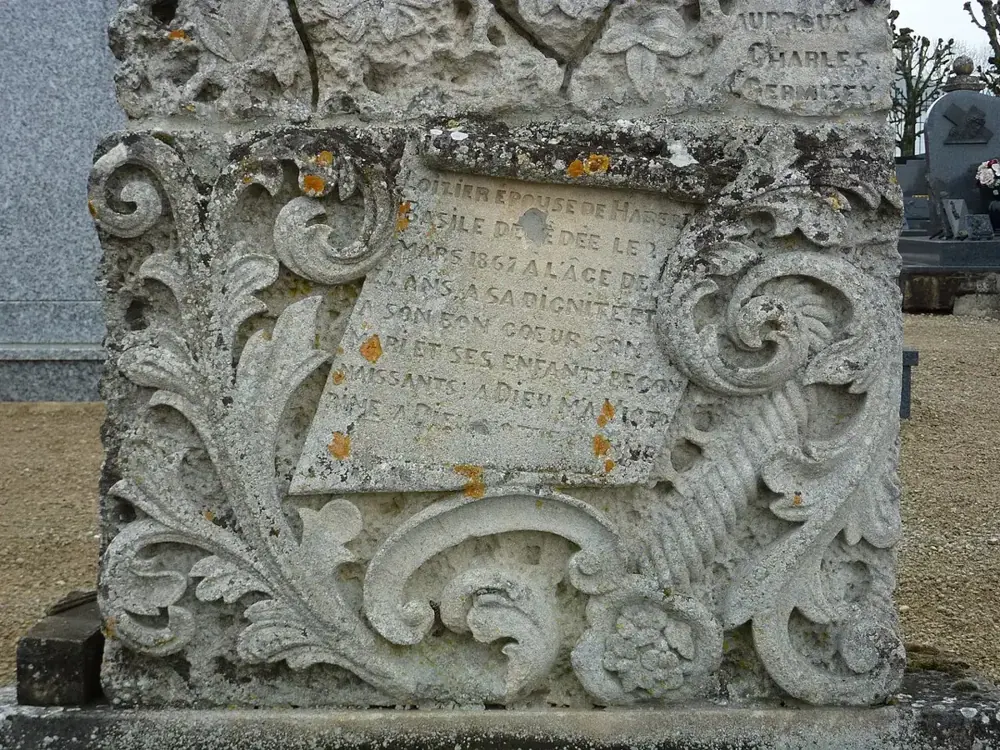
Illustrative stock photograph: 2026-04-12 Gravestone in Arrimal 1.jpg by Alexkom000 · CC BY 4.0. Hosted by Wikimedia Commons. The photograph does not represent Marwaa’s work or a featured service location.
An uncertain gravestone transcription should preserve the words you can see and clearly mark what remains unreadable. Keep a direct transcription separate from a proposed interpretation. Record the photograph, date and viewing limits so another reader can check your work without mistaking a guess for text carved on the stone.
What is the purpose of the transcription?
A transcription records an inscription; an interpretation explains what the recorder thinks it may mean. Both can be useful, but combining them without labels loses evidence. If a worn line seems to read “Mary,” that possibility should not silently become a confirmed name in a family database.
Decide whether the work is for a private family file, a cemetery survey or a public genealogy project. A project may have its own notation rules. Follow those rules where applicable. For a private record, define a simple notation key and keep it with the text.
Preserve what the stone actually shows
Copy the line order, spelling, punctuation and visible letter case where practical. Do not modernize an unfamiliar spelling in the direct transcription. Keep decorative marks separate from letters if their function is uncertain. Describe a symbol rather than assigning a meaning you have not established.
If a line is partly hidden or outside the safe viewing position, record that limit. “Not visible in this photograph” means something different from “no inscription.” The worn headstone reading guide covers basic observation; this article concerns how to record the remaining uncertainty.
Before treating old wood as a disposable temporary marker, read the Historic Wooden Grave Markers: Preserve the Record.
Choose and explain a notation key
| Situation | Example private notation | Meaning |
|---|---|---|
| Entire word unreadable | [unreadable word] | The record does not supply a reading |
| Some letters visible | MA[unclear]Y | Visible parts remain separate from the gap |
| Proposed reading | Interpretation: “Mary?” | A suggestion, not copied text |
| Surface not visible | [area obscured] | More observation may be possible later |
| Editorial comment | Note: line ends at broken edge | Context outside the inscription |
This is one suggested private-file system, not a universal transcription standard. If contributing to a database, use its defined format instead. Never substitute your own brackets in a way that makes an existing project interpret uncertainty as literal inscription text.
For a separate readable display rather than recutting original text, see the Show a Historic Inscription Without Recutting It.
Keep the source photograph connected
Assign each image a file name and record which lines it supports. Preserve an unchanged original even if you make a brighter viewing copy. Label processing on the copy so a future reader knows it is not the raw photograph.
Do not use digital sharpening or generative reconstruction as proof of missing letters. A processed image can make an edge easier to inspect, but it can also create a misleading impression. Record any assisted reading as a proposal until the actual source supports it.
Request an independent reading
Give a second reviewer the photograph and the notation key before showing them your favoured interpretation. Ask them to identify visible characters and uncertain areas. Comparing independent notes can reveal an assumption that both people otherwise repeat.
For another language or script, seek a suitably knowledgeable reader. An unreadable character and an unfamiliar character are different problems. Keep the original script in the record, then label any transliteration or translation separately with the reviewer’s name and date.
Example: a gap that changes a family connection
Suppose the visible inscription reads “daughter of JO...” and a family tree suggests the father was Joseph. The direct transcription should stop at the letters visible. A separate research note may explain the possible connection and cite the tree or record supporting it.
Later, a clearer historical photograph might confirm a different name. Because the first recorder preserved the gap, the family can revise the interpretation without rewriting the original evidence. This is more useful than a confident transcription whose source no longer supports it.
Publish uncertainty as clearly as certainty
The Heritage Newfoundland and Labrador transcription guidance provides recording conventions. The Discovering England’s Burial Spaces recording guide offers a different project framework. Their conventions are references to consult, not a single mandatory format for every North American cemetery.
Keep uncertain readings out of a new production inscription until the family has resolved the wording. If conflicting dates are involved, use the date-record comparison guide. A historical transcription should remain evidence, not automatically become an engraving instruction.
Key Takeaways
- A direct gravestone transcription and an interpretation should remain separate records.
- A clear notation key prevents uncertainty from becoming false precision.
- Photo processing and family-tree clues do not prove missing inscription characters.
Frequently Asked Questions
Should I correct old spelling in the transcription?
Preserve it in the direct transcription and put any modernized reading in a separate note.
Are brackets always the right notation?
No. Follow the receiving project’s conventions or define your private-file notation clearly.
Can AI reconstruct an unreadable name reliably?
A generated reconstruction is not evidence of the carved text. Keep uncertain characters explicitly unresolved.
Next Step
Compare your source records with the conflicting inscription dates workflow before approving any new engraving.
Read More
- How to Read a Worn or Faded Headstone Without Damaging It
- How to Photograph a Headstone for Records and Genealogy
- Conflicting Dates for a Headstone: Resolve the Wording First
A Note on This Guide
The examples describe an editorial recordkeeping method. They do not authorize cleaning, rubbing, moving or testing a stone. Respect cemetery access rules and keep recording work within safe, permitted observation.
Published by Marwaa Team for Marwaa Memorials (marwaamemorials.com) · Published 2026-11-21 · Updated 2026-11-21 Marwaa Memorials is a factory-direct exporter of bulk granite monuments and headstones, shipping to monument dealers, funeral homes, and importers across North America.
Related guides
How to Read a Worn or Faded Headstone Without Damaging It

Keep the Record When a Memorial Is Relocated

Writing a Letter to Leave at a Grave
A Family Headstone Decision Record: Agree Choices Without Losing Changes
How to Honour a Loved One Without a Grave