Memorial Sandblasting Media: Compare the Actual Process
Memorial sandblasting media are the particles used to remove exposed stone during abrasive blasting.
By Marwaa Team · Editorial standards · Published
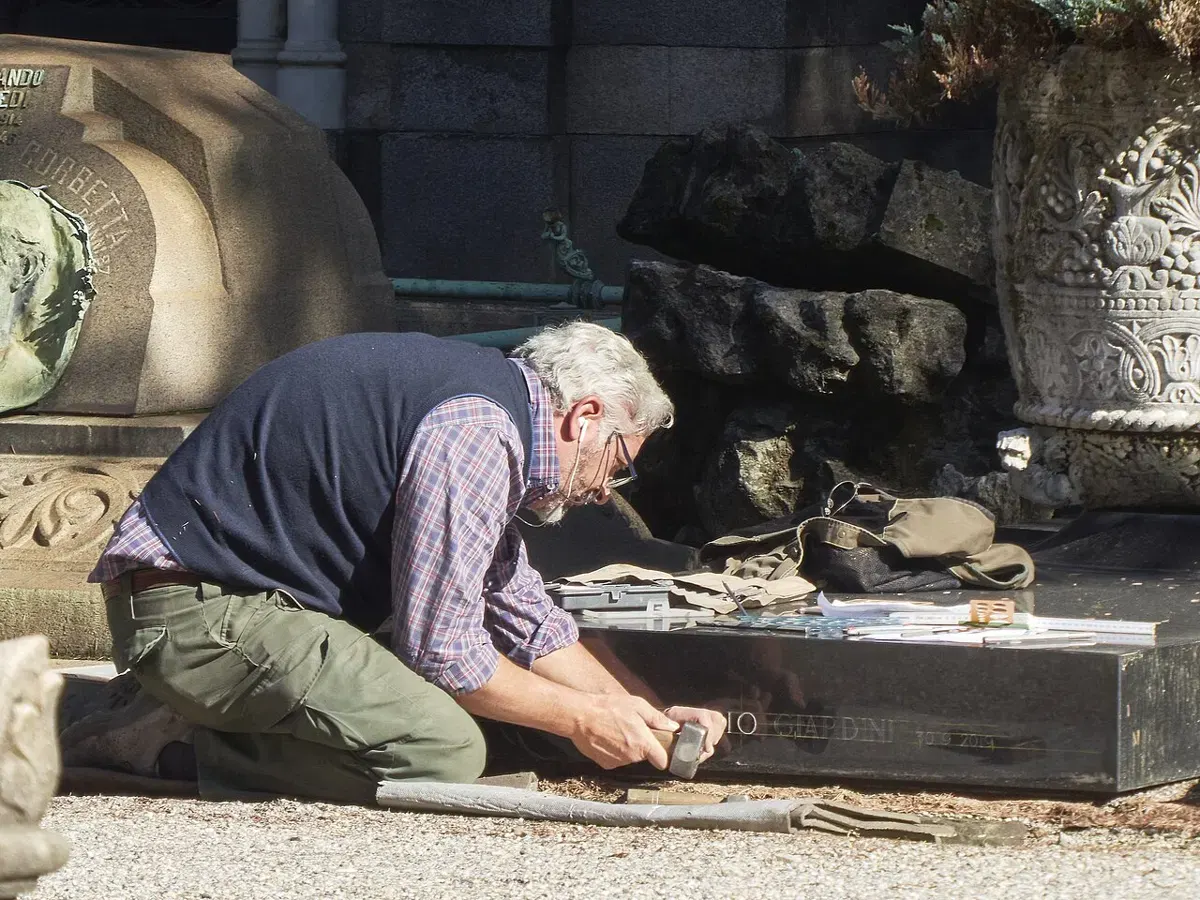
Illustrative stock photograph: 0404 Stone mason Milan.jpg by Virtual-Pano · CC BY-SA 4.0. Resized and converted to WebP. The photograph does not represent Marwaa’s work or a featured service location.
Memorial sandblasting media are the particles used to remove exposed stone during abrasive blasting. Their material, size and behaviour affect the process, but a media name alone does not define the finished inscription. Buyers should specify the required surface and detail, then let the responsible workshop select and control a suitable system. Lower-silica media do not remove all dust hazards from blasting granite.
What does memorial sandblasting media mean?
Sandblasting is a familiar trade term, but the abrasive is not necessarily ordinary sand. Producers offer several materials for monument work. The particles strike exposed areas while a resist protects the parts intended to remain.
Rayzist's sandcarving film descriptions show that the mask, abrasive and intended work form a system. Manufacturer instructions concern particular products. They should not become universal settings for every stone or workshop.
A buyer normally needs a clear inscription or texture, not a favourite abrasive brand. If a process is contractually important, explain why and agree its scope. Otherwise, describe the required result and relevant accepted reference.
Why the particle choice matters
Particles differ in hardness, shape and how they break during use. Those differences can affect removal and the resulting surface. Particle size is another variable, so two products sharing a material name may not behave identically.
The workshop also controls the rest of the system. Mask resistance, equipment, stone and the required detail all interact. It is misleading to attribute every sharp edge or rough area to one media label without considering those factors.
For a buyer, the practical comparison is a relevant finished example. Identify its stone and treatment. A sample made for another purpose may not demonstrate the depth or fine detail required by this order.
Does a different abrasive eliminate silica exposure?
No. The stone itself can contribute respirable crystalline silica when disturbed. Replacing a silica-containing abrasive does not remove that source. Other media and process dust can introduce additional concerns as well.
OSHA explains the crystalline silica hazard. The employer or responsible contractor must assess its actual work and controls. A product marketed as low dust or low silica is not a complete safety plan.
The separate silica and alteration guide explains the buying-level responsibility. This article supplies no pressure, exposure estimate or personal protective equipment specification.
Compare the inscription, not an isolated ingredient
A letter can have a clear outline but an unsuitable surface treatment, or good depth with an unintended texture. Review those aspects against the accepted design. Do not turn a method preference into automatic acceptance of the result.
The factory discussion should establish the proposed supply and any unusual finish requirements. Where a buyer requires a specific media restriction, provide it before production. Ask the workshop to explain whether it can meet both that restriction and the product requirements.
Spent abrasive is another stream to manage. Its condition depends on what it has contacted, not only what the new product contained. Avoid describing used media as harmless or freely reusable without an appropriate assessment. A useful process account follows the abrasive through the work rather than stopping at the label on the unopened bag.
Abrasive condition can change during reuse. New and previously used material should not be assumed identical merely because the label began the same. The workshop may need to control particle changes and contamination within its process. If an unusual surface appears, ask for an assessment of the complete operation rather than demanding a media substitution without understanding the cause.
Practical distinctions
| Question | Evidence or explanation | Limit to keep clear |
|---|---|---|
| Abrasive | Material and particle characteristics | A name does not define the entire process |
| Finished work | Relevant stone, lettering and surface | Judge the accepted result |
| Dust and waste | The actual work and used material | A substitution is not complete hazard control |
Key Takeaways
- Abrasive selection is one part of a complete stone-blasting process.
- A media label does not guarantee the finished lettering or texture.
- Changing the abrasive does not remove silica generated by the stone.
Frequently Asked Questions
Does sandblasting always use sand?
No. The trade term includes work with several abrasive materials.
Does low-silica abrasive make granite blasting dust-free?
No. The stone can still generate respirable silica and other process hazards remain.
Should a buyer choose media from a blog chart?
The responsible workshop needs to select and control the actual process. Buyers should state the required result and any restrictions.
Discuss a trade project
For a bulk memorial order, send Marwaa the intended material, design and unresolved requirements. Ask for an order-specific response before approving production.
Read More
- Headstone Engraving Methods Compared: Sandblast, Laser, Hand-Carved and More
- Silica Dust: Why Memorial Alterations Belong in a Workshop
A Note on This Guide
This guide provides no blasting settings or workplace control plan. Rules and controls require task-specific professional assessment. This educational guide does not replace project-specific advice from the responsible supplier, designer or installer. Confirm cemetery requirements where the proposed product or alteration needs approval.
Published by Marwaa Team for Marwaa Memorials (marwaamemorials.com) · Published 2026-11-25 · Updated 2026-11-25 Marwaa Memorials is a factory-direct exporter of bulk granite monuments and headstones, shipping to monument dealers, funeral homes, and importers across North America.
Related guides
Granite Polish: Abrasives Are Different From Coatings
Cut Stencils and Photoresist in Headstone Production
Monument Freight: Chargeable vs Actual Weight

Stone Workshop Water Recycling: What Buyers Can Ask

Replacement Monument Airfreight: Compare the Options