Granite Rift, Grain and Hardway: What the Terms Mean
Granite rift, grain and hardway describe preferred splitting directions in some stone.
By Marwaa Team · Editorial standards · Published · Updated
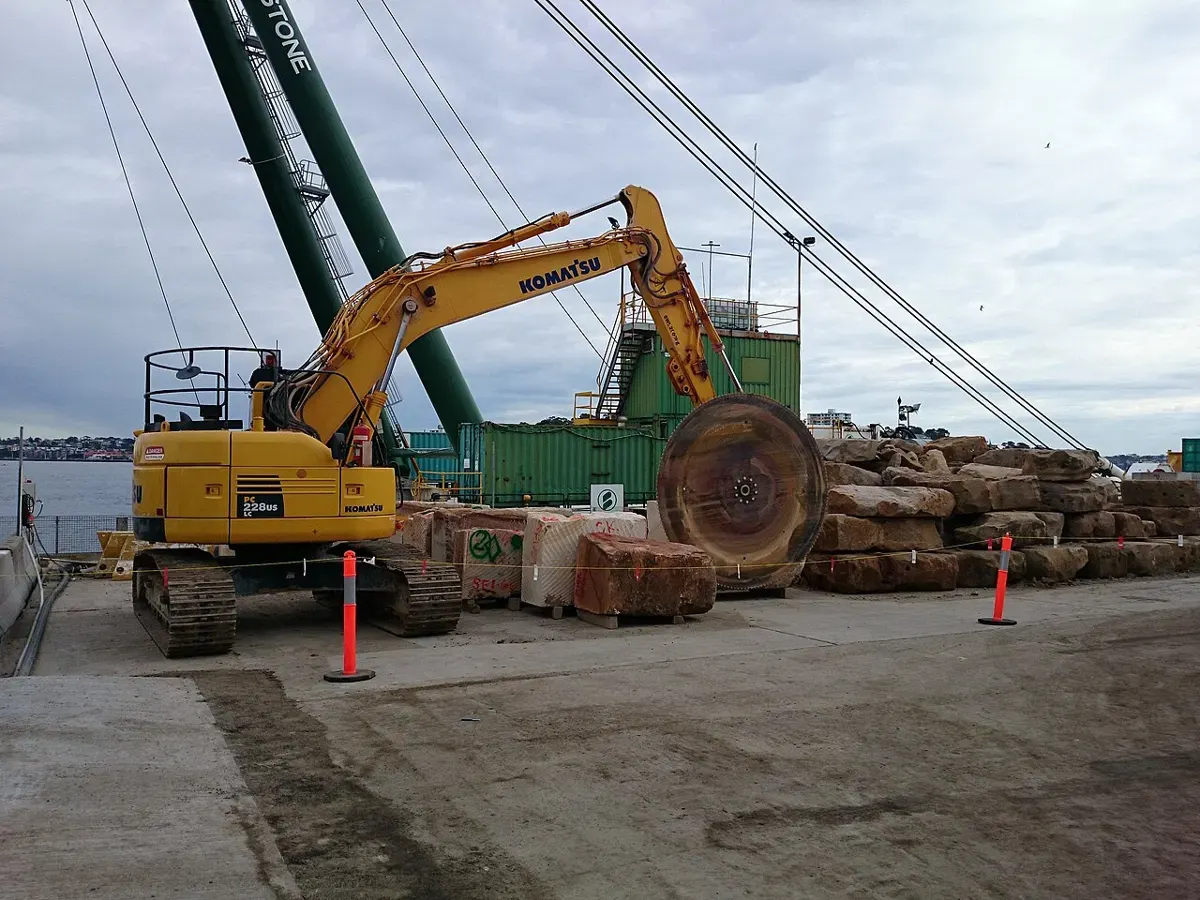
Illustrative stock photograph: Komatsu PC228USLC-8 excavator with stone saw attachment at Barangaroo.jpg by Bidgee · CC BY-SA 3.0. Resized and converted to WebP. The photograph does not represent Marwaa’s work or a featured service location.
Granite rift, grain and hardway describe preferred splitting directions in some stone. Rift is the easiest direction to split, grain is another direction, and hardway is the most difficult. These quarry terms do not mean the visible colour streaks are wood grain. A buyer should distinguish how a block splits from how its pattern looks and how the finished component will be designed.
What do granite rift, grain and hardway describe?
A large block can behave differently when split in different directions. Quarry workers use terms for these differences. Rift is the easiest splitting direction. Grain is a second direction. Hardway describes the direction that is hardest to split.
The International Tunnelling Association glossary describes these directions in massive quartz-bearing igneous rocks. The terms help explain quarry practice. They are not a complete engineering description of a particular memorial stone.
A buyer usually sees a finished slab or monument, not the original block. That makes the words easy to misread. Grain can refer to visible crystals in everyday conversation, yet in this quarry context it means a splitting direction. Ask which meaning the speaker intends.
How is splitting direction different from a visible pattern?
A stone may have bands, veins or a directional mix of minerals. Those features affect its appearance. They do not automatically identify the easiest splitting plane. A photograph of a stripe is therefore not enough to label rift or hardway.
Likewise, turning a pattern horizontally on a drawing does not show how the parent block was split. The workshop may use sawing as well as splitting to produce the required form. Different operations respond to different material features.
Keep two separate conversations. One concerns the visible arrangement of the stone across the design. The other concerns how the producer can safely and reliably make the part from the available material. Confusing them can cause a decorative request to be mistaken for a technical instruction.
A deliberately rock-pitched edge and a natural-cleft surface are different descriptions, even when both look irregular. See Rock-Pitched vs Natural-Cleft Stone: Know the Difference.
Why does the distinction matter in a memorial workshop?
A maker planning a tall narrow element, a carved opening or a projecting feature needs to understand the stone and the intended form. Splitting behaviour can be one part of that understanding. It does not set a universal rule for every stone sold under the same commercial name.
The actual geometry matters. A simple rectangular tablet and a detailed cross do not ask the material to do exactly the same job. Supports, handling, joints and final installation also affect the design. None should be decided from a glossary term alone.
A dealer can explain the desired outcome without directing an unfamiliar shop operation. Describe the visible faces, shape and pattern preference. Ask the fabricator to identify any conflict between those preferences and its proposed method. Qualified technical review belongs with the people responsible for that work.
What information is useful on a drawing?
Label the front, back, top and sides so a pattern request has a clear reference. If a directional appearance matters, show the intended direction on the visible face. Use an actual material image or sample where helpful, while acknowledging the range in natural stone.
Do not simply write cut with the grain unless its meaning has been agreed. That phrase could refer to appearance, splitting or another workshop convention. An ambiguous instruction can survive several drawing revisions because each person thinks it is clear.
For repeat monument production, preserve the agreed visual intent separately from the producer's method. A later block may need a different cutting arrangement while still producing an acceptable appearance. If the method itself is a contractual requirement, state it precisely and explain why it matters.
What should a buyer avoid claiming?
Do not promise that an arrow on a sales image guarantees structural performance. Do not assume a stone without visible bands has no preferred splitting direction. Both claims confuse appearance with material behaviour.
The practical value of these terms is clearer discussion between quarry, workshop and buyer. They help explain why a producer may ask about orientation or propose a different layout. The final decision still needs to consider the particular stone, component and use. A short definition can prevent confusion, but it cannot replace that judgement.
Compare the questions before choosing
| Area | What it explains | Practical limit |
|---|---|---|
| Crystal grain | The visible size and arrangement of crystals | Relevant to appearance and lettering |
| Pattern direction | A visual band or flow on a face | Show the intended direction on drawings |
| Splitting direction | Rift, grain or hardway in quarry use | Leave technical assessment to the responsible producer |
Key Takeaways
- The visible size and arrangement of crystals. Relevant to appearance and lettering.
- A visual band or flow on a face. Show the intended direction on drawings.
- Rift, grain or hardway in quarry use. Leave technical assessment to the responsible producer.
Frequently Asked Questions
Is hardway a lower grade of granite?
No. It names a splitting direction, not a quality grade or a separate material.
Can I identify rift from a catalogue photograph?
Not reliably. Visible pattern and preferred splitting direction are different matters.
Should a dealer specify cut with the grain?
Only if everyone has agreed what that phrase means. Clear face labels and a visual direction are better for an appearance request.
Discuss the trade requirement
For a bulk memorial project, send the intended material, design and use to Marwaa. Ask for a clear response to the questions that affect your order before approving production.
Read More
- How Are Headstones Made? From Quarry Block to Cemetery
- Where Does Headstone Granite Come From?
- Granite Relief Carving: Review a Production Sample
A Note on This Guide
These are general quarry terms. The guide does not identify splitting planes in a supplied block or provide a structural design rule. This is general educational guidance for dealers and other buyers. The people responsible for the project should resolve material, cemetery and technical requirements for the actual order.
Published by Marwaa Team for Marwaa Memorials (marwaamemorials.com) · Published 2026-11-23 · Updated 2026-11-23 Marwaa Memorials is a factory-direct exporter of bulk granite monuments and headstones, shipping to monument dealers, funeral homes, and importers across North America.
Related guides

Granite Crystal Grain and Headstone Lettering

Commercial vs Geological Granite for Memorials
Waterjet Stone Inlays for Memorials: Design Tradeoffs

Pet Memorial Stones: Granite Markers for Dogs, Cats and Other Pets

Granite Monument Care and Maintenance: The Dealer's Guide to Educating Families [2026]