Granite Headstone Foundation Requirements Explained
How headstone foundations work, typical depth and thickness specs, who pours them, and why foundation rules cause the most installation delays.
Key Takeaways
- A foundation is a poured concrete base beneath the headstone, distinct from the monument itself, and it's rarely included automatically in a stone's purchase price.
- Typical foundation depth runs 24 to 30 inches, with the concrete extending about 4 inches beyond the monument's footprint on each side, but exact specs are set by the individual cemetery.
- Some cemeteries require their own staff to pour the foundation; others allow an approved outside installer, but only to written specifications.
- Foundation fees are usually billed separately from the headstone itself and scale with the monument's size.
- Confirming who pours the foundation, and to what spec, before finalizing an order prevents the most common cause of installation delay.
What a Foundation Actually Does
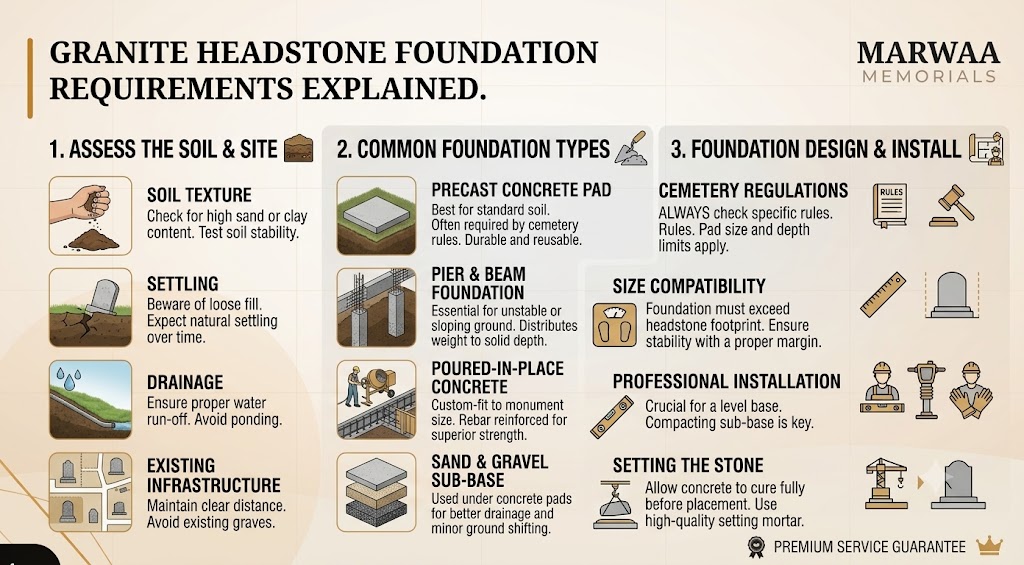
Granite headstones are heavy, often several hundred pounds for a modest upright monument, and they sit on ground that was recently disturbed by digging the grave. Without a solid, level base beneath it, a monument can tilt, sink unevenly, or crack over the following years as the soil settles and shifts with weather.
The foundation solves this the same way a house foundation does: a poured concrete footing, sized and reinforced to the weight and footprint of what sits on top of it, that spreads the load and resists movement. Colder climates typically need deeper foundations, since the concrete has to sit below the frost line to avoid heaving when the ground freezes and thaws.
Typical Foundation Specifications
Foundation rules vary enough by jurisdiction that no single number is universal, but the patterns below show up repeatedly across cemeteries that publish their specifications:
| Spec | Typical range | Notes |
|---|---|---|
| Depth | 24-30 inches, up to 36-42 in colder climates | Deeper in areas with a lower frost line |
| Overhang beyond monument | About 4 inches on each side | Larger monuments sometimes require more |
| Concrete thickness | 4-6 inches minimum | Thicker for larger or taller monuments |
| Reinforcement | Rebar in some jurisdictions | Not universal; check local cemetery rules |
| Curing time | About 1 week before the stone can be set | 72 hours minimum before formwork is removed |
Flat markers generally need a lighter foundation than upright monuments, since they distribute weight over a wider area and place less lateral stress on the ground. Some cemeteries waive a separate foundation requirement for flat markers entirely and simply set them on a prepared gravel bed.
Who Pours the Foundation
This is the detail that causes the most confusion, because the answer differs by cemetery and it isn't always the same party selling the headstone.
Cemetery-poured: many cemeteries require their own staff or an in-house contractor to pour every foundation, regardless of who supplied the monument. The family or dealer pays a separate foundation fee to the cemetery.
Approved outside installer: some cemeteries allow a licensed, insured installer to pour the foundation, but only to the cemetery's written specifications, and often only after the cemetery has approved the installer.
Included with the monument: less common, but some full-service monument providers handle foundation and installation as part of one quote.
Confirming which of these applies to a specific cemetery, in writing, before finalizing an order avoids the situation where a finished monument arrives with nowhere approved to set it.
Foundation Costs
Foundation costs are typically billed separately from the headstone and scale with size, since a larger monument needs a bigger, deeper footing. Some cemeteries calculate the fee by the footprint (length times width times depth), others charge a flat rate by monument category. Either way, it's worth asking for the foundation fee as a separate line item when comparing quotes, since a quote that looks lower on the stone alone can end up costing more once foundation and setting fees are added.
A note for dealers: foundation specs are one of the most productive things to confirm in writing before production begins, not after. A base or footprint that's a half-inch outside a cemetery's foundation tolerance is a genuinely common cause of a rejected installation, and it's far cheaper to catch in the design-approval stage than after a finished monument has shipped.
Next Step
If you're finalizing a design and want to confirm foundation compatibility before production begins, our Request a Quote page is the fastest way to get specifics on a given size and base.
Foundation depth, thickness, and reinforcement requirements vary by individual cemetery and by local jurisdiction, and sometimes change without much notice. What's described here reflects common patterns across published cemetery specifications, not a universal standard. Before finalizing a foundation plan, confirm the exact requirements with the specific cemetery office directly.
Frequently Asked Questions
Is a foundation included when you buy a headstone?
Not usually. The headstone purchase and the foundation are typically billed and arranged separately, often through the cemetery itself rather than the monument provider. Always ask specifically whether foundation costs are included in a quote or billed on top of it.
How deep does a headstone foundation need to be?
Most cemeteries require somewhere in the 24 to 30 inch range, deeper in colder climates where the foundation needs to sit below the frost line. The exact depth is set by each individual cemetery, so this should be confirmed directly rather than assumed.
Can I pour my own foundation?
Most cemeteries require a professional, often licensed and insured, to pour the foundation, both because of the weight and safety involved and because the cemetery needs it to meet exact specifications. Some cemeteries allow small flat markers to be set differently, but this varies enough that it's worth confirming directly.
Does a flat marker need the same foundation as an upright headstone?
Generally no. Flat markers distribute weight over a wider area and put less stress on the ground, so many cemeteries require a lighter foundation, or simply a prepared gravel bed, for flat markers compared to the concrete footing an upright monument needs.
What happens if a foundation isn't built to the cemetery's specification?
The cemetery can require the monument to be lifted, the foundation corrected, and the stone reset, usually at the family's or installer's expense. This is exactly the kind of costly rework that confirming specifications in writing before production is meant to prevent.
Ready to get pricing for your granite monument?
Request pricing, factory specifications, and DAP delivery timelines from our team.