Importing Granite Monuments to Australia: What's Different
How importing granite headstones and monuments to Australia differs from the USA and Canada, including biosecurity, duties, and GST.
Key Takeaways
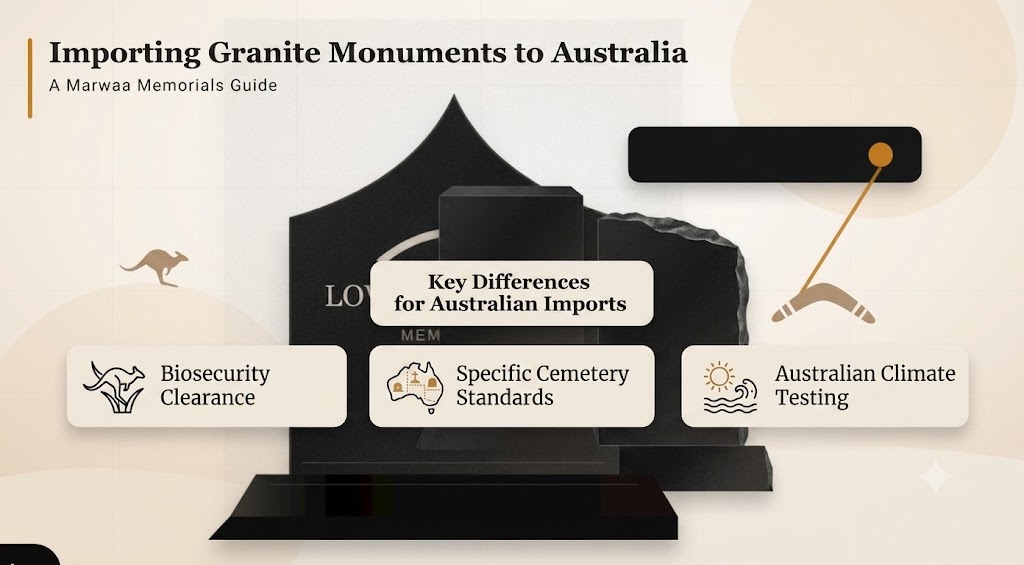
- Australia's Department of Agriculture, Fisheries and Forestry (DAFF) enforces biosecurity inspections on stone imports that go beyond standard customs clearance.
- Granite must arrive free of organic contamination, soil, plant material, or timber residue, or the container risks quarantine treatment, re-export, or destruction.
- Standard import duty on general cargo is commonly around 5% of the FOB value, with 10% GST applied on top, though the exact rate depends on the product's HS code and country of origin.
- Documentation requirements mirror North American shipments (commercial invoice, packing list, bill of lading) with the addition of biosecurity-specific paperwork depending on packaging materials used.
- Full-container-load shipping is generally more secure than consolidated LCL for granite monuments, given the added handling risk at Australian ports.
Biosecurity: The Step That Doesn't Exist the Same Way in North America
Australia's geographic isolation means its biosecurity authority treats almost every category of import as a potential pathway for pests, disease, or invasive species, and stone products aren't exempt just because they're inert. The concern isn't the granite itself; it's what might be attached to it or packed around it.
Commercial-grade granite for monuments needs to be free of soil, plant material, insects, and timber residue before it's crated. Wooden crating and dunnage, which is standard practice for protecting stone during ocean transit, is itself a biosecurity item and typically needs to meet ISPM 15 treatment standards (heat treatment or fumigation, with the certification mark stamped on the wood) before Australian authorities will clear it.
If a container arrives with contamination the inspection flags, options are limited and expensive: treatment on arrival, re-export at the importer's cost, or destruction. None of these are common when factories follow clean-processing practices from the start, but they're a real enough risk that Australian orders are worth an extra pass at the packing stage compared to a North American shipment.
Duties and GST
Most general cargo entering Australia, including natural stone products, attracts a standard customs duty in the range of 5% of the FOB value, though the exact rate depends on the specific HS code classification and whether the country of origin has a free trade agreement with Australia that reduces or eliminates it. On top of duty, GST applies at 10% of the total dutiable value, which includes the CIF value plus any duty owed.
| Charge | Typical rate | Applied to |
|---|---|---|
| Customs duty | Often around 5%, varies by HS code and origin | FOB value |
| GST | 10% | Customs value plus duty plus freight and insurance |
| Biosecurity inspection/treatment (if flagged) | Varies | Per container, only if contamination is found |
Documentation
Australian customs clearance shares most of its paperwork requirements with a standard North American import: commercial invoice, packing list, and bill of lading are the baseline for any shipment. A certificate of origin becomes relevant if the shipment qualifies for preferential tariff treatment under a free trade agreement, and it's worth confirming with a customs broker whether the country of manufacture has one with Australia before assuming a reduced rate applies.
A note for dealers: working with a customs broker experienced specifically in natural stone imports, not just general cargo, is worth the fee on an Australian order. Stone-specific brokers know which HS code classifications and packaging documentation reduce inspection friction, and that familiarity tends to shorten clearance time more reliably than a generalist broker working through it case by case.
Shipping Method
Full-container-load (FCL) shipping is generally the safer choice for granite monuments heading to Australia, more so than for North American shipments where LCL consolidation is more common for smaller orders. The extra handling involved in LCL consolidation adds both breakage risk and another point where a container gets opened and re-inspected, which matters more under Australia's stricter biosecurity regime than it does under standard US or Canadian customs handling.
Next Step
If you're a dealer or importer evaluating Australia as a new market for granite monuments, our Request a Quote page can walk through current FOB and DAP pricing for Australian ports, and our Export Countries page covers where we currently ship.
Import duty rates, GST calculations, and biosecurity requirements are set by Australian government authorities and change over time. What's described here reflects general patterns at the time of writing, not a substitute for confirming current requirements with a licensed customs broker or the Australian Border Force and Department of Agriculture, Fisheries and Forestry directly before shipping.
Frequently Asked Questions
Is importing granite monuments to Australia more expensive than to the USA or Canada?
Not necessarily on duty and GST alone, since those track fairly closely with general cargo rates. The added cost usually comes from biosecurity compliance, proper wood treatment certification, clean processing at the factory, and the extra margin of care that avoids inspection delays, rather than from duty rates themselves being dramatically higher.
What triggers a biosecurity hold on a granite shipment?
Organic contamination is the most common trigger: soil, plant material, insects, or untreated wood packaging. Clean stone processing and ISPM 15-treated crating materials are the main ways to avoid this at the source rather than dealing with it at the port.
Does Australia have a free trade agreement that reduces granite import duty?
It depends on the country of origin. Australia maintains free trade agreements with a number of countries that can reduce or eliminate standard duty rates for qualifying goods, but eligibility depends on the specific rules of origin for that agreement and needs to be confirmed against the current classification, not assumed.
How long does customs and biosecurity clearance typically take in Australia?
It varies by port and whether biosecurity flags anything for inspection. A clean shipment with proper documentation generally clears in a timeframe comparable to North American customs processing; a shipment that gets flagged for biosecurity inspection can take meaningfully longer while treatment or further review happens.
Ready to get pricing for your granite monument?
Request pricing, factory specifications, and DAP delivery timelines from our team.