How to Tell if a Granite Monument Is High Quality
A practical guide to evaluating granite monument quality, covering color consistency, polish, thickness, and the defects worth walking away from.
Key Takeaways
- Color consistency across the entire piece, not just the visible face, is one of the fastest and most reliable quality signals.
- A genuine high-quality polish reflects light clearly and feels smooth and even under the hand, with no rough or dull patches.
- Visible fissures, pitting, or color blotching usually indicate a lower grade of granite, even if the piece still looks acceptable in a warehouse.
- Monument granite should generally run thicker than countertop-grade slabs; thinner cuts save material cost but compromise long-term durability and resistance to chipping.
- A supplier's willingness to explain grading, sourcing, and QC process in specific terms is itself a quality signal worth weighing.
Color Consistency
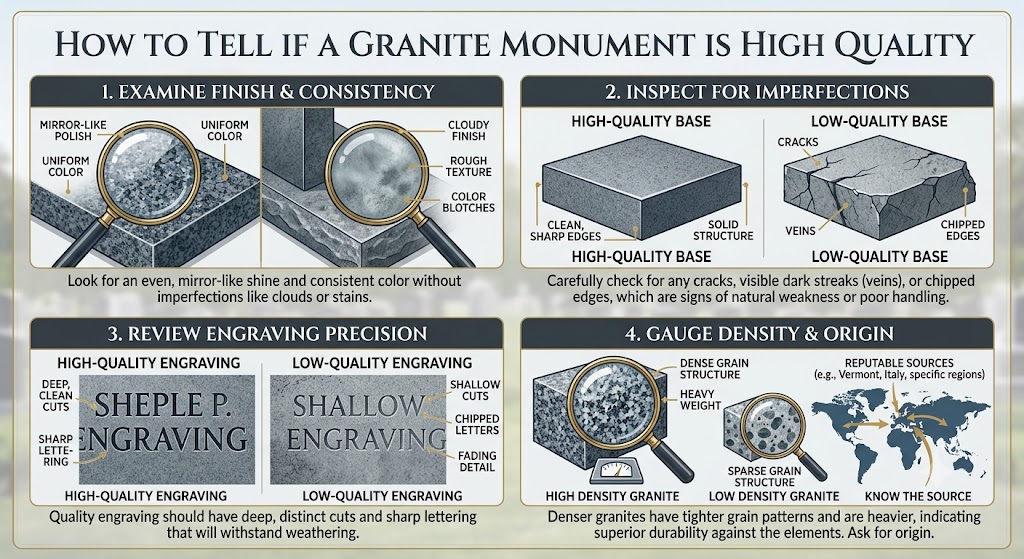
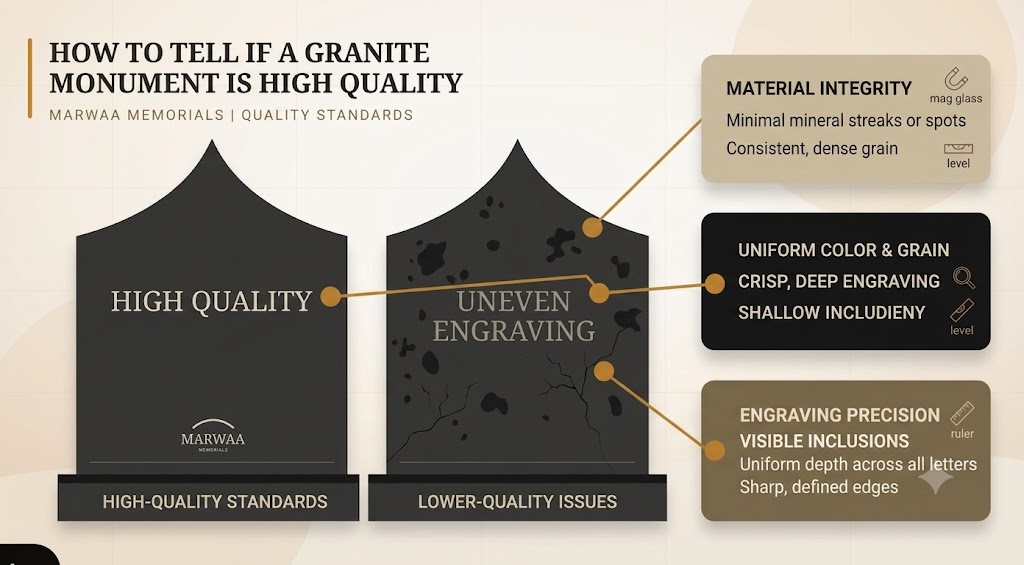
Consistent color across a stone, not just on the polished face but through the base and back as well, is one of the clearest signs of higher-grade granite. Variations, streaking, or blotchy patches within what should be a uniform color often indicate a lower grade, even when the visible face looks fine at first glance.
This matters more than it might seem for one practical reason: if a dealer orders a run of matching headstones, say ten pieces in the same granite color for a bulk cemetery order, inconsistent grading across the batch means the pieces won't actually match once they're standing in a row. Checking color consistency across multiple pieces from the same order, not just within a single stone, catches this before it becomes a customer complaint.
Polish Quality
A genuinely high-quality polish reflects light clearly and produces something close to a mirror effect on a dark stone. Running a hand across the surface should feel smooth and even, without rough patches, dips, or areas where the polish clearly didn't take evenly.
Uneven polish isn't just cosmetic. It's often a sign of rushed finishing or lower-grade equipment in the polishing process, and it tends to correlate with other corners cut elsewhere in production. A stone that looks fine under warehouse lighting but shows dull, uneven patches outdoors in direct sun is a common complaint that traces back to this exact issue.
Fissures, Pitting, and Natural Defects
Granite is a natural material, and small, hairline fissures are normal and don't indicate poor quality on their own; some are even considered part of the stone's natural character. The distinction that matters is between minor natural variation and visible cracks, chips, or pitting concentrated enough to affect structural integrity or long-term appearance.
A quick check: hold the stone at an angle under strong light and look across the surface rather than straight at it. Fissures, pits, and polish inconsistencies that aren't obvious head-on often show up clearly at an angle.
Thickness
Monument granite should generally be thicker than granite cut for countertops or flooring, since a headstone needs to withstand decades of freeze-thaw cycles, wind load on an upright stone, and the physical risk of impact or vandalism that a countertop never faces. Thinner cuts save material cost for the supplier, but they compromise the exact durability that's the entire point of choosing granite in the first place.
There's no single universal minimum, since required thickness scales with the size and type of the monument, but a supplier who can't specify the thickness of a given piece, or who quotes a noticeably thinner spec than comparable pieces from other suppliers at a similar price, is worth a direct question before ordering.
Quality Signals Compared
| Signal | What to check | What it usually indicates |
|---|---|---|
| Color | Consistency across face, base, and back; consistency across a batch | Inconsistency suggests lower grade or mixed-batch sourcing |
| Polish | Mirror-like reflection, smooth even feel by hand | Dullness or unevenness suggests rushed finishing |
| Fissures/pitting | Angle the stone under light; look for concentration, not isolated hairlines | Heavy concentration suggests lower-grade material |
| Thickness | Compare against the monument type and size, not just price | Thinner-than-typical cuts often trade durability for cost |
| Supplier transparency | Willingness to explain grading and QC specifics | Vague or evasive answers are themselves a signal |
A Note From the Production Side
For dealers: the fastest way to evaluate a new supplier isn't a sample piece alone, it's asking specific questions about their QC process before a sample ever ships. A supplier who can describe exactly where in production color and polish get checked, and by whom, is a different kind of partner than one who says "we use good granite" without specifics. Ask what happens to a piece that fails an internal QC check before it reaches you; a supplier with a real answer to that question, not a vague one, is generally the supplier worth building a long-term relationship with.
Next Step
If you're evaluating a new granite supplier or want to see current grading and QC documentation before your first order, our Request a Quote page is a direct way to start that conversation, and our How to Choose a Granite Monument Supplier guide covers the broader supplier evaluation process.
Frequently Asked Questions
What's the difference between Grade A and lower-grade monument granite?
Grade A granite typically shows consistent color and pattern with minimal visible fissures or pitting and a smooth, even polish. Lower grades show more visible variation, more natural defects, and often a less consistent finish, though there's no single universal grading standard across every supplier.
Can I tell granite quality just by looking at a sample piece?
A sample tells you a lot, color, polish, and visible defects are all checkable by eye and by hand, but it doesn't tell you whether that quality is consistent across a full production run. Asking about batch consistency and QC process matters as much as evaluating one piece.
Does a higher price always mean higher-quality granite?
Not automatically, though price and grade often correlate. The more reliable approach is checking the specific signals, color consistency, polish, thickness, and defect concentration, directly rather than assuming price alone tells the full story.
Why does granite thickness matter for a headstone specifically?
A headstone faces decades of freeze-thaw cycles, wind load, and physical impact risk that indoor applications like countertops never encounter. Thinner cuts save material cost but are more prone to chipping and cracking over the monument's lifespan.
Are small fissures in granite always a defect?
No. Small, hairline fissures are natural to the stone and common even in high-grade granite. The concern is visible cracking, heavy pitting, or fissures concentrated enough to raise questions about structural integrity, not the presence of any natural variation at all.
Ready to get pricing for your granite monument?
Request pricing, factory specifications, and DAP delivery timelines from our team.