Granite Monument Shipping: FCL vs LCL Containers, Ocean Freight Costs & Port Timelines [2026]
Everything monument dealers need to know about shipping granite monuments by ocean freight — FCL vs LCL, real freight costs, port timelines, and how to avoid demurrage.

Ocean freight is the backbone of every successful granite monument import program — and it is also where the most expensive mistakes happen. Demurrage charges, missed peak season stock, and damaged product from inadequate packaging are all logistics failures, not product failures. This guide explains every freight decision a monument dealer needs to make before their first container moves, with real numbers for 2026.
If you are still sourcing through a domestic distributor and have not explored direct import, the wholesale granite monuments sourcing guide is the right starting point. This guide assumes you are ready to manage freight directly or are evaluating whether the logistics burden is worth taking on.
FCL vs LCL: The Decision That Shapes Your Landed Cost
Every monument dealer importing granite will quickly encounter two container shipping terms: FCL (Full Container Load) and LCL (Less than Container Load). Understanding the difference is essential because the choice directly determines your cost per unit.
Full Container Load (FCL)
In an FCL shipment, you book an entire container — typically a 20-foot or 40-foot unit — for your exclusive use. The container is loaded, sealed at the factory, and opened at your destination warehouse. FCL is the standard for established dealers running serious annual volumes.
FCL advantages for granite dealers:
- Lowest per-unit freight cost at volume
- Sealed container reduces handling-related damage risk
- Complete customs entry on one manifest
- No co-loading delays from other shippers
- Direct control over container contents and packing arrangement
Less than Container Load (LCL)
LCL consolidates cargo from multiple shippers into one container. You pay only for the cubic meters and weight your product occupies, plus a handling surcharge. It sounds cost-efficient — but granite is exceptionally dense, and LCL pricing for heavy goods often erodes the apparent savings entirely.
LCL considerations for granite:
- Granite's density means you often pay weight-based surcharges, not just volume
- Co-loading introduces handling touches that increase edge-chip risk
- Longer port processing time due to deconsolidation at destination
- Practical for first-time trial orders only; rarely efficient at any serious stocking volume
Recommendation: Monument dealers ordering more than 40–60 pieces per shipment should almost always be on FCL. The economics are significantly better and the logistics complexity is lower. Discuss this with the Marwaa team when requesting your quote.
Container Sizes: What Fits and What to Order
| Container Type | Internal Dimensions | Practical Granite Payload |
|---|---|---|
| 20-foot standard (20GP) | 5.9m × 2.35m × 2.39m | ~18,000–21,000 kg |
| 40-foot standard (40GP) | 12.0m × 2.35m × 2.39m | ~24,000–26,000 kg |
| 40-foot high-cube (40HC) | 12.0m × 2.35m × 2.69m | ~24,000–26,000 kg, extra vertical clearance |
Granite reaches weight limits before volume limits in most container types. Your exporter's Container Load Plan (CLP) — which should be issued and approved before booking — will show the exact piece count, weight distribution, and stacking arrangement for your specific product mix.
Ocean Freight Transit Times: South Asia to North America and Australia
| Origin Port | Destination | Typical Transit |
|---|---|---|
| Chennai, India | US East Coast (New York/Baltimore) | 22–32 days |
| Chennai, India | US Gulf Coast (Houston) | 28–38 days |
| Chennai, India | US West Coast (LA/Long Beach) | 20–28 days |
| Chennai, India | Canada East (Halifax/Montreal) | 26–38 days |
| Chennai, India | Canada West (Vancouver) | 22–30 days |
| Chennai, India | Australia (Sydney/Melbourne) | 20–28 days |
| Tuticorin, India | US East Coast | 24–34 days |
These are transit times only. Add production lead time (typically 2–4 weeks from order confirmation) and post-arrival port processing time (7–14 days) to get your full door-to-door timeline. The import guide for USA and Canada covers the full timeline calculation in detail.
Real Ocean Freight Costs in 2026
Freight rates fluctuate significantly based on global supply chain conditions, fuel surcharges, and seasonal demand. As a planning reference for 2026:
| Lane | 20-foot FCL | 40-foot FCL |
|---|---|---|
| South Asia → US East Coast | $1,800–$3,200 | $2,800–$4,800 |
| South Asia → US West Coast | $1,400–$2,800 | $2,200–$4,200 |
| South Asia → Canada East | $2,000–$3,500 | $3,000–$5,200 |
| South Asia → Australia | $1,600–$3,000 | $2,600–$4,600 |
These are market-rate estimates — actual quotes from freight forwarders will vary. Always get freight quotes before finalizing your total landed cost calculation. Include all-in costs: BAF (Bunker Adjustment Factor), PSS (Peak Season Surcharge), and destination terminal handling charges.
Export Packaging Standards That Protect Your Product
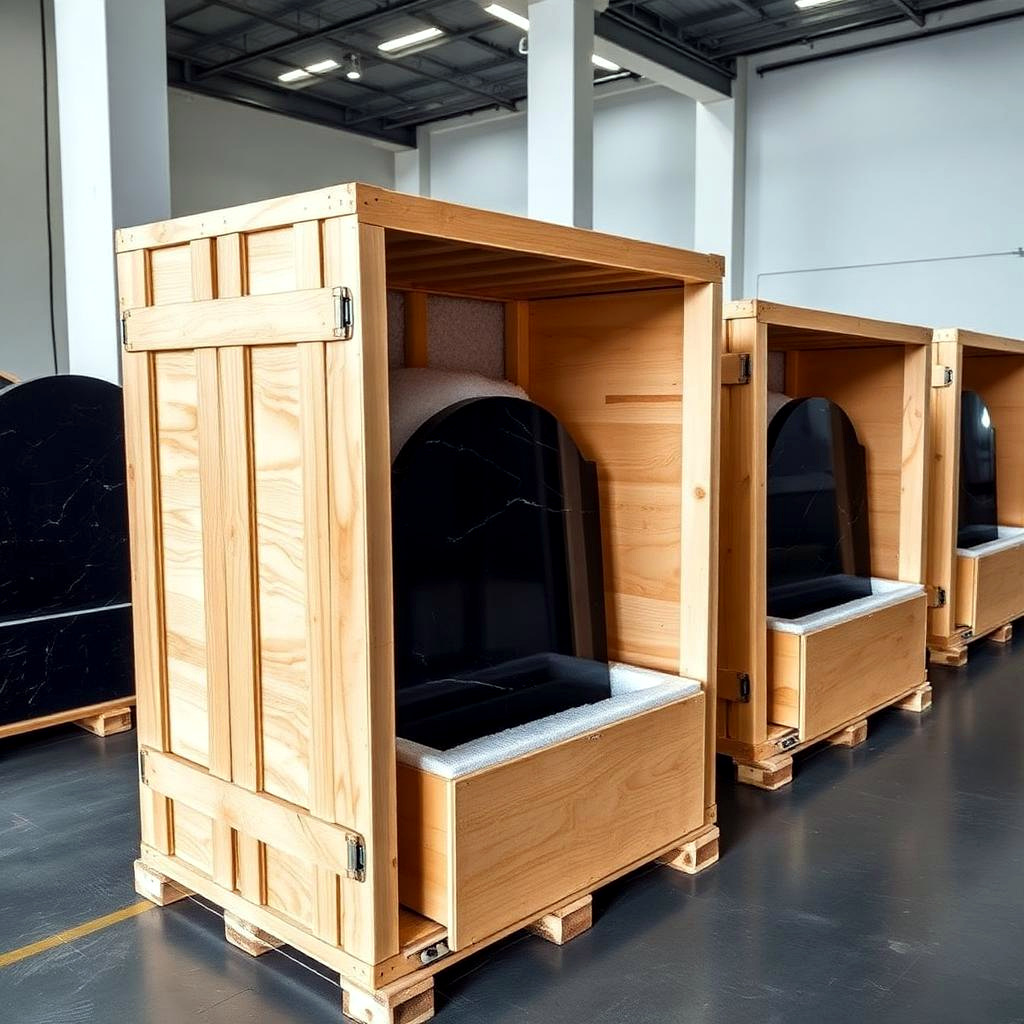
A container of granite monuments arrives at destination in exactly the condition it was packed. Proper export packaging is not optional — it is the difference between full-value inventory and breakage claims.
The standard that experienced monument importers require:
- ISPM-15 compliant heat-treated wooden crating for all wooden packaging materials — required by US, Canadian, and Australian biosecurity regulations
- Individual foam-lined wooden cradles for each upright headstone piece
- Foam corner protection on all finished edges
- Polyethylene moisture wrapping for each piece before crating
- Strapped and banded pallets for flat markers and accessories
- Container load plan compliance — no stacking of crated uprights beyond rated crate capacity
Confirm your exporter's specific packaging procedure before the container is loaded. The supplier checklist includes packaging standard as a scored evaluation point.
Key US and Canadian Ports for Granite Monuments

Port selection affects both transit time and inland delivery cost:
USA entry ports:
- New York/Newark (Port Newark) — primary entry for Eastern US and Midwest dealers
- Baltimore (Seagirt Marine Terminal) — strong for Mid-Atlantic monument markets
- Houston (Barbours Cut) — natural entry for Southern US distribution
- Los Angeles / Long Beach — West Coast primary entry; high volume, longer inland for East Coast dealers
- Savannah — growing rapidly; strong access to Southeast and Midwest via I-75/I-85
Canadian entry ports:
- Halifax — primary Eastern Canada entry
- Montreal — efficient for Quebec and Ontario dealers
- Vancouver — primary Western Canada entry
How to Avoid Demurrage and Detention Charges
Demurrage and detention fees are among the most preventable costs in granite monument importing — and among the most expensive when they occur. Here is how to avoid them:
- Confirm customs broker appointment before the vessel arrives. Do not wait for arrival notice to start paperwork.
- Have all documentation reviewed before the ship departs origin. Commercial invoice errors cause CBP exam requests — the single most expensive delay source.
- Pre-file your customs entry. US CBP allows pre-filing 5 days before vessel arrival. Use it.
- Know your free days at origin (detention) and destination (demurrage). Standard FCL: 3–7 free days at origin, 3–5 free days at destination, depending on carrier and port. Negotiate extended free time for large-value containers.
- Have inland delivery arranged before the container clears. Warehouse appointment, carrier booking, and driver confirmation — all before port release.
A reliable export partner like Marwaa issues all documentation 5–7 days before vessel departure, giving your customs broker the maximum runway to file ahead of arrival.
Your Total Landed Cost Formula
Every buying decision should be made against total landed cost, not FOB unit price:
Total Landed Cost per Unit =
  FOB price per unit
+ (Ocean freight ÷ number of units)
+ (Customs duty at applicable rate)
+ (Port handling fees ÷ units)
+ (Customs broker fees ÷ units)
+ (Inland delivery ÷ units)
Request an FOB quote from Marwaa Memorials and your freight forwarder's all-in door rate to build an accurate cost model before committing to a container.
Frequently Asked Questions
What is the difference between FCL and LCL shipping for granite monuments?
FCL (Full Container Load) means you book an entire container exclusively. LCL (Less than Container Load) means your cargo shares a container with other shippers. FCL is almost always more cost-effective for granite monuments because granite's extreme density means LCL weight-based surcharges erode the apparent per-cubic-meter savings quickly. Dealers ordering more than 40–60 pieces should almost always ship FCL.
How long does ocean freight from India to the USA take for granite monuments?
Typical ocean transit from South Indian ports (Chennai, Tuticorin) to US East Coast ports is 22–34 days. Add 2–4 weeks production lead time and 7–14 days post-arrival port processing for a realistic door-to-door total of 7–11 weeks from purchase order to delivery at your facility.
What is ISPM-15 and why does it matter for granite monument imports?
ISPM-15 is the international biosecurity standard for heat-treated wooden packaging materials. US, Canadian, and Australian customs authorities require all wooden crating, pallets, and dunnage to be ISPM-15 certified. Non-compliant wooden packaging can result in customs holds, re-export orders, or destruction of packaging — all at the importer's cost.
How do I calculate total landed cost for a granite monument container?
Total landed cost per unit equals FOB price per unit, plus ocean freight divided by number of units, plus applicable customs duty, plus port handling fees divided by units, plus customs broker fees divided by units, plus inland delivery cost divided by units. Always model this full calculation before evaluating a supplier's FOB price — the unit-cost impact of freight, duty, and logistics varies significantly by origin port, destination, and container size.
Which US ports are best for importing granite monuments?
The best US entry port depends on your location. New York/Newark serves Eastern US and Midwest well. Baltimore suits Mid-Atlantic dealers. Houston is the natural entry for Southern distribution. Los Angeles/Long Beach for West Coast. Savannah is growing fast with strong I-75/I-85 inland access for Southeast and Midwest markets.
Ready to get pricing for your granite monument?
Request pricing, factory specifications, and DAP delivery timelines from our team.