Companion Memorials: A Layout Plan for Future Lettering
Plan reserved lettering space on a companion memorial with an annotated proof, wording rules and records a future engraver can understand.
By Marwaa Memorials · Published
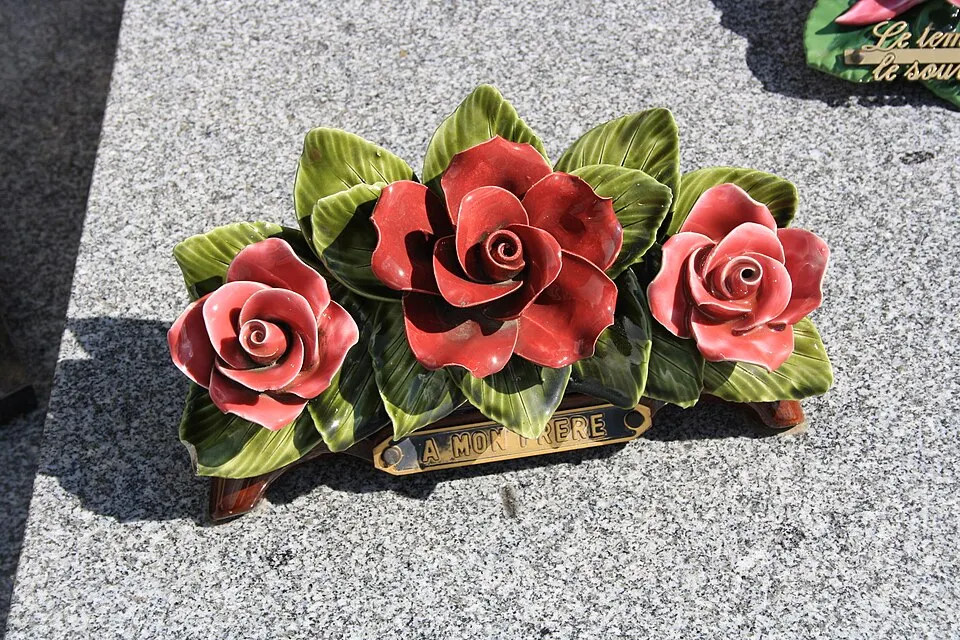
Illustrative stock photograph: Saint Remy les Chevreuse Cemetery Fake Ceramic Flowers 05 by Lionel Allorge · CC BY-SA 3.0. Resized and converted to WebP. The photograph does not represent Marwaa’s work or a featured service location.
A companion memorial may be installed while one person's inscription is incomplete. The useful question is not simply whether an empty area remains. It is whether a future engraver can understand the intended layout without guessing, and whether the cemetery permits the proposed later work.
Mark present and future text differently
Ask the supplier for a proof that clearly distinguishes text to be engraved now from an outline or note showing possible future text. Make sure a placeholder date is not mistaken for a production instruction. The production proof should identify what will actually be cut, while a separate annotated record can explain the future plan.
The engraving design guide covers the broader design choices. This guide focuses on preserving a usable instruction record for the later stage, rather than selecting a particular font or promising that every design can be matched.
Complete this future-lettering record
| Item | Information to retain |
|---|---|
| Reserved area | Labelled position on the approved drawing |
| Intended text | What is known now and what will be decided later |
| Lettering | Font or lettering reference, size and alignment supplied by the maker |
| Surface | Granite identification and face finish in the supplier's specification |
| Artwork | Reference to any nearby symbol, portrait or border |
| Later work | Contact process and any written exclusions or conditions |
| Cemetery | Current permission and a reminder to confirm requirements again later |
Avoid relying on a casual description such as “same as the other side.” The original lettering may have details a photograph does not capture, and a future supplier may not have the same artwork files or equipment.
Test the longest plausible wording without treating it as final
Use sample text to ask the supplier whether the reserved layout is workable. Label the sample as a planning example, not an instruction to engrave. Consider the future date format, any relationship wording and whether the family may want an additional short line.
In a fictional example, the family initially reserves only a death-year position. During review, it realizes that the other inscription includes a full day, month and year. The supplier can then show a consistent arrangement before production. This is a layout discussion, not a universal measurement rule for every stone.
Ask how later engraving would be arranged
Ask whether future lettering is normally performed on site or requires other arrangements for this design and cemetery. Seek a written description of what is and is not included in the current order. If a future service is quoted separately, ask about its conditions and how long that quotation remains valid.
Do not read a reserved blank space as a promise of free later engraving. Access requirements, permission, travel, cleaning preparation and the condition of the memorial may need to be considered when the later work is actually requested.
Keep the record accessible to a future contact
Save the approved proof, annotated future plan, invoice and supplier details together. Include an unedited front photograph after installation. Tell the family's chosen future contact where the documents are kept; do not make one person's old email account the only route to the lettering record.
When the future addition is needed, retrieve the files before requesting a new quote. Have the new wording verified, ask the cemetery about current permission and follow the proof revision process. Prior planning helps explain the intention but does not replace a new approval where one is required.
Source and scope
Greenfield Cemetery's monument guidance illustrates that inscription and permission requirements are cemetery-specific. The worksheet and fictional layout example above are original planning aids. Obtain the actual requirements for your grave and later work.
Frequently Asked Questions
Does a blank space include future engraving in the price?
Only if the written order expressly includes that service under stated conditions. Ask the supplier rather than assuming.
Should a sample future date appear on the production proof?
It must be unmistakably labelled so it cannot be engraved accidentally. Ask the supplier how it separates planning notes from production instructions.
What records will a future engraver need?
Keep the approved layout, lettering reference, material and finish specification, supplier contact and clear installation photographs.
Ready to get pricing for your granite monument?
Request pricing, factory specifications, and DAP delivery timelines from our team.
Related guides
Adding a Couple's Photo to a Companion Headstone

Headstone Fonts and Lettering Styles
Husband and Wife Headstone Wording

Headstone Lettering Colours
Gold Leaf Headstone Lettering
