
CNC Roughing and Hand Finishing for Carved Memorials
CNC roughing and hand finishing can work together in a carved memorial.
By Marwaa Team · Published
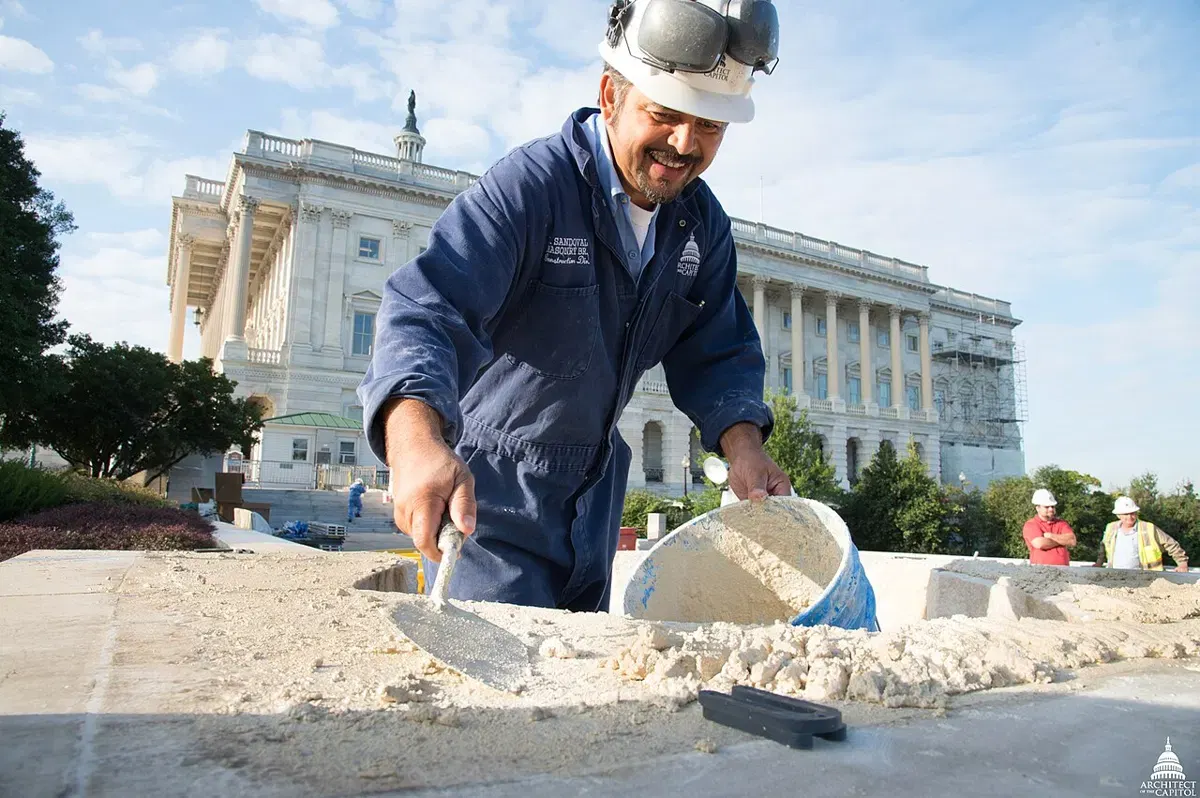
Illustrative stock photograph: AOC Stonemason Repairs Olmsted Terrace (15404517305).jpg by USCapitol · Public domain. Resized and converted to WebP. The photograph does not represent Marwaa’s work or a featured service location.
CNC roughing and hand finishing can work together in a carved memorial. A machine may remove much of the unwanted stone from a digital model. A carver can then refine surfaces, detail and transitions that need further attention. The division varies by design and workshop. Buyers should judge the accepted model and finished carving rather than assuming either method alone guarantees artistic quality.
What does CNC roughing and hand finishing mean?
Roughing removes material to establish the broad form. CNC means a computer controls the tool path. The machine follows instructions derived from a model, but it does not decide what the sculpture should express. People still create, adapt and review the design.
Hand finishing describes later work performed by a craftsperson. It can include refining a fold, changing a surface, clarifying an edge or working an area a tool could not reach well. Some pieces need extensive hand work. Others are designed to suit a largely machine-led process.
A stone carving producer's process explanation describes this mixed route. It is an example of one production approach, not proof that every workshop follows the same stages.
Why a digital model is not the finished stone
The model describes a shape. The stone introduces colour, crystal pattern, surface texture and the limits of a real cutting tool. A smooth area on screen can look quite different once carved in a strongly patterned material.
Tool access also matters. A machine approaches the work along paths permitted by its setup. Deep recesses and sheltered areas can be harder to reach. A proposed design may need adaptation, a different setup or later hand work. Those changes should preserve the agreed intent rather than quietly removing an important feature.
Ask which parts of the model are the visual priorities. On a figure, they may include the face and hands. On a floral carving, the important feature may be the depth between overlapping petals. The buyer can then review the actual result against a clear purpose.
What does hand work add?
Hand work can connect forms in ways that a roughing stage has not resolved. A carver may soften a transition or make a deliberately sharp edge read clearly. Texture can also become part of the design rather than a trace of the cutting process.
More hand work is not automatically better. Uncontrolled changes can move a carving away from the accepted reference. The useful question is what the finishing is intended to achieve and how the buyer will review it.
The phrase hand-finished can mean different amounts of work. Do not assume that it means every part was carved from the raw block by hand. Equally, machine-assisted does not mean no artistic judgement was involved. Clear descriptions are more useful than labels designed only to sound impressive.
How should a dealer discuss a carving commission?
Begin with the subject, material, size and intended viewing angles. Explain which features must remain recognizable. A small portrait likeness and a broad decorative relief create different review needs. A generic statement that the carving must be detailed does not settle either one.
A catalogue design can be a starting point, but a change in scale can alter the result. Ask the workshop how a smaller version affects deep folds, thin projections or tiny facial details. Some details may need simplification to remain clear in the chosen stone.
If a physical example is needed, agree what it demonstrates. A detail sample may answer a question about a face or texture. It does not automatically show the handling or appearance of the complete figure. Keep the scope of that evidence clear.
Assess the work rather than the prestige of the method
A well-made carving should suit its accepted design and purpose. Visible tool marks may be intentional in one texture and unwanted in another. A highly polished area can be correct on one design and distracting on another. Method alone cannot settle those questions.
Use full views to assess proportion and close views for details. Avoid approving only flattering angles that hide important transitions. The best review connects the model, actual material and finished form. That gives both buyer and maker a useful reference without reducing the work to a machine-versus-hand contest.
Compare the questions before choosing
| Area | What it explains | Practical limit |
|---|---|---|
| Digital model | Defines the intended form | Does not reproduce real mineral pattern |
| Roughing | Removes bulk material | May leave areas for later work |
| Hand finishing | Refines agreed features and texture | Needs a clear reference, not an unlimited claim |
Key Takeaways
- Defines the intended form. Does not reproduce real mineral pattern.
- Removes bulk material. May leave areas for later work.
- Refines agreed features and texture. Needs a clear reference, not an unlimited claim.
Frequently Asked Questions
Does CNC mean a carving is mass-produced?
Not necessarily. The same type of tool can support a one-off commission or repeat work. Ask how the actual design will be made.
Is hand finishing proof that a piece is fully hand-carved?
No. It describes a stage and can follow machine roughing. Ask for a clear process description if that distinction matters.
Can any digital model be carved at any size?
No. Stone, tool access, detail and geometry can limit the result. Review any proposed changes at the intended scale.
Discuss the trade requirement
For a bulk memorial project, send the intended material, design and use to Marwaa. Ask for a clear response to the questions that affect your order before approving production.
Read More
- Granite Relief Carving: Review a Production Sample
- Headstone Engraving Methods Compared: Sandblast, Laser, Hand-Carved and More
- How Are Headstones Made? From Quarry Block to Cemetery
A Note on This Guide
This guide explains a possible combination of methods. It does not promise a particular machine route, level of hand work or portrait likeness for an unreviewed design. This is general educational guidance for dealers and other buyers. The people responsible for the project should resolve material, cemetery and technical requirements for the actual order.
Published by Marwaa Team for Marwaa Memorials (marwaamemorials.com) · Published 2026-11-23 · Updated 2026-11-23 Marwaa Memorials is a factory-direct exporter of bulk granite monuments and headstones, shipping to monument dealers, funeral homes, and importers across North America.
Related guides
Headstone Engraving Methods Compared: Sandblast, Laser, Hand-Carved and More

Praying Hands on a Headstone: Meaning and Design Ideas

Pointing Hand on a Headstone: Meaning

Clasped Hands on a Headstone: What They Mean

Hand Holding a Flower on a Headstone: Meaning
