
Monument Truck Weight: Payload Is Not the Only Limit
A monument load can fall below a container's payload rating and still require a road-weight review. The truck, chassis, axle arrangement and actual route impose separate constraints. Give the carrier accurate cargo and package information, then obtain its acceptance for the movement. A container plate or total mass figure alone does not establish that a road journey is legal or suitable.
By Marwaa Team · Editorial standards · Published
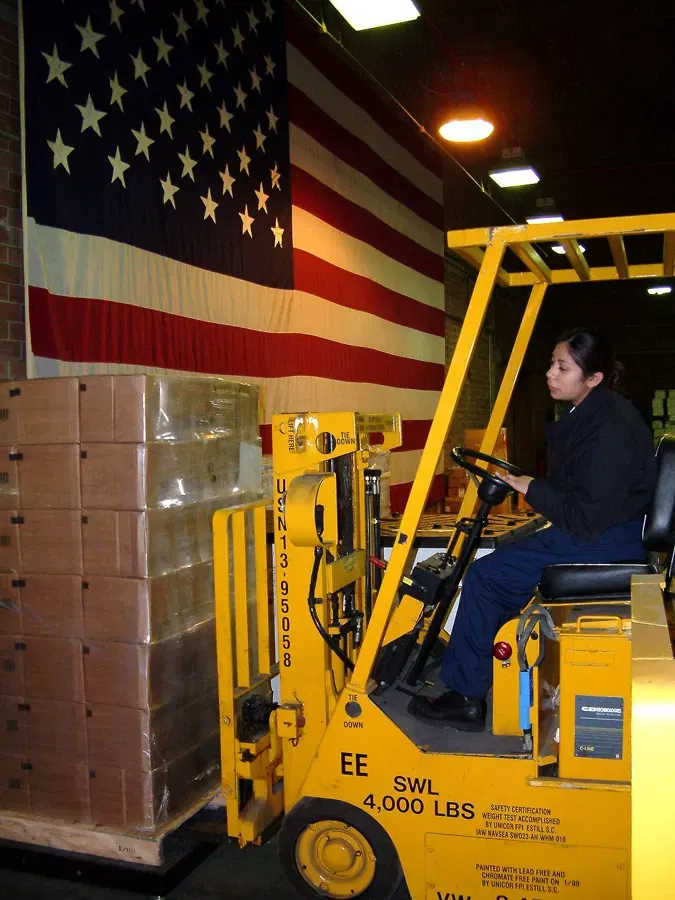
Illustrative stock photograph: US Navy 030407-N-5821W-001 Storekeeper Seaman Estella Perez operates a forklift in order to weigh a pallet of Tastykake snacks.jpg by U.S. Navy photo by Journalist Seaman Stephen P. Weaver. · Public domain. Resized and converted to WebP. The photograph does not represent Marwaa’s work or a featured service location.
A monument load can fall below a container's payload rating and still require a road-weight review. The truck, chassis, axle arrangement and actual route impose separate constraints. Give the carrier accurate cargo and package information, then obtain its acceptance for the movement. A container plate or total mass figure alone does not establish that a road journey is legal or suitable.
Which weights describe different things?
Product mass describes the stone or finished item. Package mass adds the relevant packing. Packed-container mass includes the container and its contents. A road vehicle adds further equipment and distributes the load through its axles. These values should not be treated as interchangeable.
The verified gross mass guide explains the packed-container declaration. That declaration has a distinct purpose in ocean transport. A correct VGM does not by itself approve a truck's axle weights, configuration or chosen road route.
Why can axle arrangement matter?
Road rules can address individual axles, axle groups and the relationship between weight and spacing. A total that looks acceptable in isolation may therefore leave important questions unanswered. Dense stone cargo makes it especially unwise to assume that available volume is the only constraint.
The FHWA bridge-formula explanation describes the US relationship between axle spacing and bridge loading. It is background for understanding why a carrier asks technical questions, not an instruction for the dealer to calculate or approve a loading arrangement.
Why does the actual route matter?
Different jurisdictions and roads can have different requirements. A port-to-warehouse trip may cross several boundaries, encounter a bridge restriction or use a road with its own limits. The final local approach can matter even when the main highway portion is suitable.
Ask the competent carrier to assess the complete route and any necessary permissions. Do not select a convenient road from a consumer map and describe it as an approved truck route. The dealer can provide the destination and access facts without taking over the carrier's route-planning responsibility.
| Information | What it supports | What it does not prove |
|---|---|---|
| Product mass | Goods description | Total vehicle weight |
| Package data | Cargo assessment | Safe support arrangement |
| Container rating | Equipment constraint | Road legality |
| VGM | Packed-container mass declaration | Axle compliance |
| Carrier acceptance | Defined movement assessment | Suitability of a changed load or route |
How should Canadian movements be assessed?
Canada's provincial and territorial road requirements need their own review. A US federal explanation does not supply Canadian operating limits. The carrier should identify which requirements apply to the actual equipment and route, including the destination approach.
For example, Ontario's commercial vehicle information provides a jurisdictional starting point. The applicable current rules and permissions still need professional confirmation. This guide intentionally supplies no universal weight limit, because a single number would conceal the configuration and route questions.
What if the initial load is not accepted?
Ask the provider to explain which fact or constraint requires a different plan. The solution may involve another accepted equipment or service arrangement, but it should come from competent assessment. Do not instruct staff to move crates around or alter supports based on an office estimate.
If the product order changes after acceptance, disclose the updated cargo information. An additional base, heavier crate or different grouping can matter. The packed-dimensions guide reinforces the need to identify the actual transported objects rather than rely on the original stone drawing.
How can procurement avoid a late surprise?
Bring the road leg into the discussion before finalizing the freight scope. Confirm whether quoted acceptance depends on provisional cargo data, then provide final information through the agreed process. A large ocean container should not be selected merely because it offers more floor space.
Marwaa's export information supports an end-to-end service discussion. The buyer's useful contribution is accurate product and destination data, prompt notice of changes and clear questions about acceptance. The carrier and other competent providers then assess legal transport and the required technical arrangement.
Does carrier acceptance remove every shipper responsibility?
No. The business should understand its own duties under the applicable rules rather than assume that buying transport transfers every obligation. Ontario's guidance identifies responsibilities across transport participants. Provide accurate cargo facts and ask the competent adviser what the shipper must do. Carrier route expertise and the supplier's factual information should work together; neither excuses knowingly incomplete or misleading load data.
Key Takeaways
- Container payload and road legality are separate constraints.
- Axle configuration, spacing and the actual route can matter.
- Final cargo changes should be disclosed to the accepting carrier.
Frequently Asked Questions
Does an acceptable VGM prove the truck is legal?
No. VGM and road-weight compliance address different requirements.
Can the dealer choose a safe load layout from total weight?
No. Competent providers must assess loading, support and the vehicle arrangement.
Is one legal road-weight number valid across the US and Canada?
No. Applicable requirements depend on jurisdiction, configuration and route.
For a bulk monument programme, request a trade quotation with the product scope, destination and the specific questions discussed here.
Read More
- Monument Container Weight: The Verified Gross Mass Brief
- Packed Monument Dimensions vs Stone Dimensions
- Monument Inland Freight: Rail or All-Truck Route?
A Note on This Guide
This guide identifies separate weight constraints without giving legal limits or loading instructions. The competent carrier must assess current requirements, route, configuration and any permissions for the actual move.
Published by Marwaa Team for Marwaa Memorials (marwaamemorials.com) · Published 2026-11-25 · Updated 2026-11-25 Marwaa Memorials is a factory-direct exporter of bulk granite monuments and headstones, shipping to monument dealers, funeral homes, and importers across North America.
Related guides
Monument Container Weight: The Verified Gross Mass Brief
Monument Inland Freight: Rail or All-Truck Route?
Monument Cargo: Standard or Special Container?

Monument Freight: Chargeable vs Actual Weight

Headstone Ideas for a Truck Driver
