Headstone Symbols and Meanings: A Guide to Cemetery Carvings
What do the carvings on a headstone actually mean? A guide to common religious, nature, and memorial symbols families choose for granite headstones.
Religious symbols
Faith-based imagery is the most common category by far, and most carry meaning that's stayed consistent for centuries.
- Cross — the most widespread Christian symbol, appearing in dozens of variations (Latin, Celtic, ornate). Style is often a personal or denominational choice more than a doctrinal one.
- Star of David — the primary symbol on Jewish headstones, sometimes paired with Hebrew inscription.
- Crescent and star — used on Islamic memorials, though inscription style and permitted imagery vary by cemetery and tradition.
- Praying hands — a near-universal symbol of faith and devotion, used across denominations.
- Angel — represents a guardian or messenger escorting the deceased; a weeping angel specifically signals grief or an untimely death.
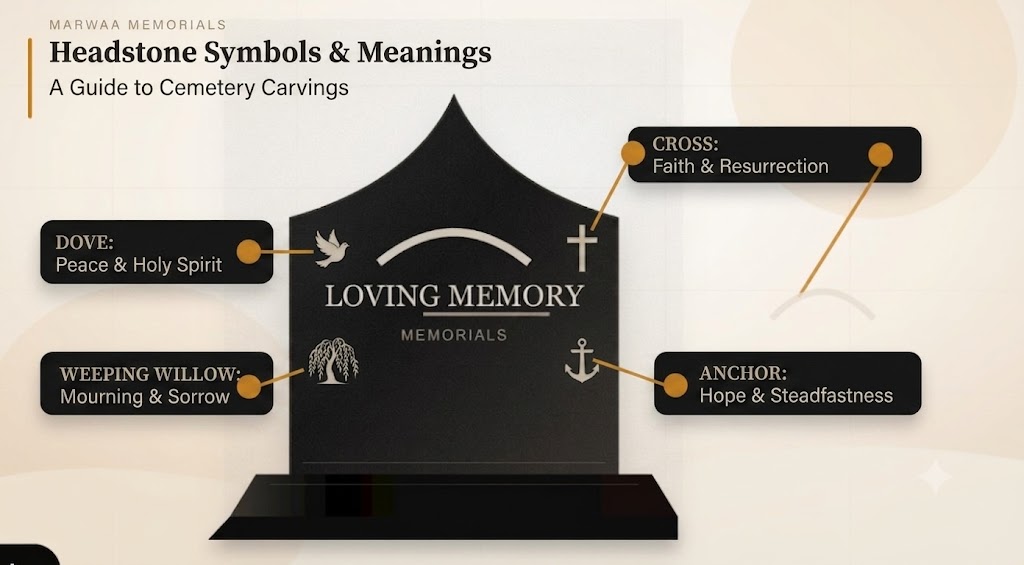
- Dove — peace and the presence of the Holy Spirit; frequently paired with an olive branch.
Nature and floral symbols
Plants and flowers carry some of the oldest symbolic language in memorial art, much of it inherited from Victorian-era "language of flowers" traditions.
- Rose — love and beauty; a rosebud (rather than a full bloom) traditionally marks a life cut short.
- Lily — purity and resurrection, especially common on Christian memorials.
- Oak leaf or tree — strength, endurance, and a long, well-rooted life.
- Ivy — enduring memory and friendship, since ivy stays green year-round.
- Wheat sheaf — a long life brought to full harvest, historically used for someone who lived to an advanced age.
Life, service, and profession symbols
Some of the most personal headstone imagery has nothing to do with religion and everything to do with what the person actually did.
- Anchor — naval service or a life connected to the sea.
- Tools of a trade — a hammer for a carpenter, a book for a teacher or scholar, a palette for an artist — a straightforward way of carving someone's life's work into the stone itself.
- Military emblems — branch insignia, rank, and service-specific symbols are common on veterans' memorials, and government-furnished headstones include an approved "emblem of belief" system for religious symbols as well. We cover eligibility for government-furnished veteran headstones in our complete headstone guide.
- Fraternal and civic emblems — Freemasonry, Eastern Star, and similar organizational symbols show up often on stones from the late 1800s through mid-1900s, and are a common clue in genealogy research today.
Symbols tied to age or relationship
- Lamb — almost always marks a child's grave, symbolizing innocence and gentleness.
- Heart — love, frequently used on companion memorials for couples.
- Interlocking rings or a unity symbol — a shared life, common on double headstones.
If you're designing a memorial for a couple, our companion and double headstone guide covers layout and symbol placement across a shared stone specifically.
Choosing a symbol for your memorial
There's no rule that says a headstone needs a symbol at all — plenty of families choose a clean design with just a name, dates, and engraving style doing the work. But when a symbol fits, it tends to be the detail people remember most about the stone.
A few practical things worth thinking through:
- Combine, don't crowd. A single well-placed symbol paired with clean lettering usually reads better than several competing images. Our custom engraving guide covers how symbol placement interacts with lettering and portrait engraving.
- Confirm with the cemetery. Some sections — particularly religious or veterans' cemeteries — restrict which symbols and emblems are permitted. Worth checking before finalizing a design, the same way you'd confirm size or material.
- Sandblasting, CNC carving, and laser etching all render symbols differently — a fine botanical detail carves differently than a bold geometric emblem, so the technique matters as much as the image you pick.
Our Design Studio lets you preview motifs alongside granite color, shape, and inscription layout before requesting pricing, so you can see how a symbol actually sits on the stone rather than guessing from a catalog photo.
Key Takeaways
- Headstone symbols fall into a few broad categories: religious, nature/floral, profession or service-related, and age or relationship-specific.
- A rosebud typically marks a life cut short, while a lamb almost always signifies a child's grave.
- Military and government-furnished headstones follow a specific approved "emblem of belief" system for religious symbols.
- Some cemeteries, especially religious or veterans' sections, restrict which symbols are permitted — confirm before finalizing a design.
- A single well-chosen symbol combined with clean lettering usually reads better on the finished stone than several competing images.
Next Step
Curious how a symbol would actually look on your design? Try the Design Studio to preview motifs alongside your headstone shape and inscription, or request a quote to talk it through with our team.
Frequently Asked Questions
What does a rose on a headstone mean?
A full rose generally symbolizes love and beauty. A rosebud specifically traditionally represents a life that ended too soon, often used on the graves of children or young adults.
What symbol is used for a child's grave?
A lamb is the most common traditional symbol for a child's headstone, representing innocence and gentleness. Cherub figures are also frequently used for infants.
Can I put any symbol I want on a headstone?
Not always — some cemeteries restrict certain symbols, particularly in religious or veterans' sections. It's worth confirming with the cemetery before finalizing your design.
What does an anchor mean on a gravestone?
An anchor traditionally signifies naval service or a life connected to the sea, though it has also historically been used as an early symbol of hope and steadfastness.
Ready to get pricing for your granite monument?
Request pricing, factory specifications, and DAP delivery timelines from our team.