
Sunken Ground Beside a Grave: Who Should Inspect?
Distinguish sunken ground from a sunken grave marker, report the location to the cemetery and avoid filling or probing an unexplained depression yourself.
By Marwaa Team · Editorial standards · Published
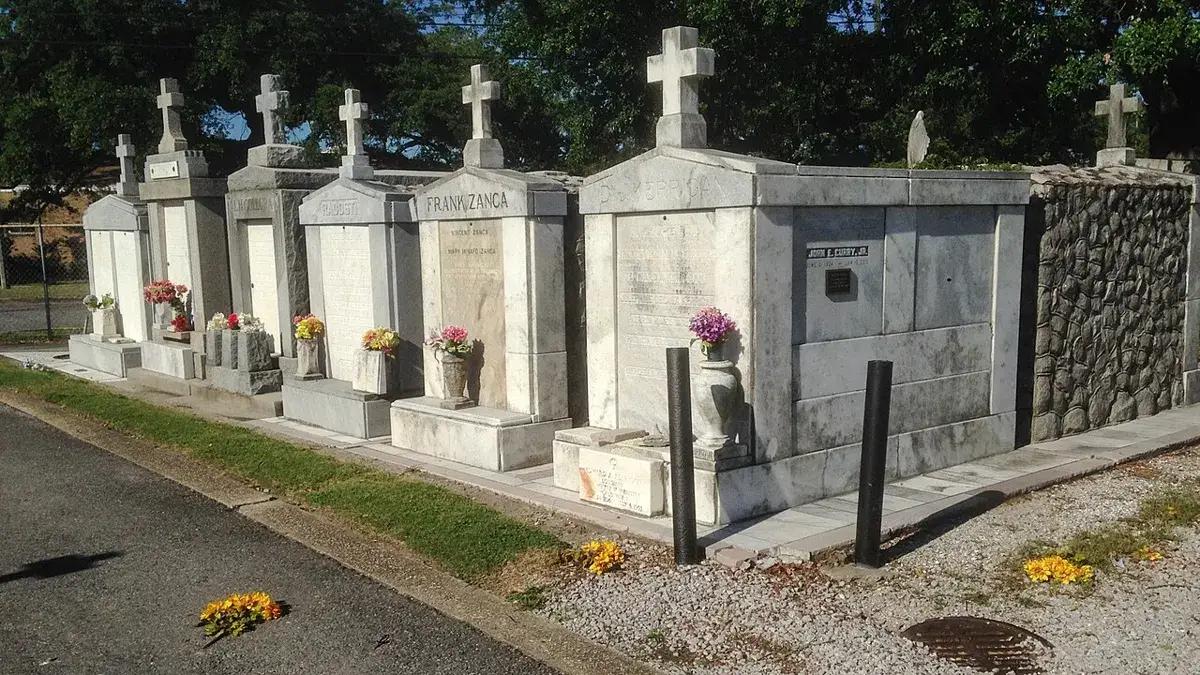
Illustrative stock photograph: Fall-Down Flowers Cypress Grove Cemetery New Orleans.jpg by Bart Everson · CC BY 2.0. Resized and converted to WebP. The photograph does not represent Marwaa’s work or a featured service location.
Sunken ground beside a grave needs the cemetery's assessment, even when the headstone still looks level. A depression in the ground and a sunken marker are different observations. Keep clear of unstable edges, report the exact location and avoid adding soil or probing the area. Staff can decide whether access restrictions, ground work or memorial inspection are needed.
What is sinking: the ground or the marker?
Look only from a safe position. A hollow in turf, a gap beside paving and a flat marker below the surrounding lawn describe different things. A visitor can report those visible conditions without deciding what is happening underground.
Do not assume the cause from a recent burial date or the appearance of the grass. Settlement, drainage and other site conditions require local assessment. A hollow is not proof of a failed coffin, damaged vault or disturbed burial.
The Southern Metropolitan Cemeteries Trust's explanation of grave sinking describes its own operational approach. It helps explain why ground change can occur, but its work methods and timing are not a universal instruction for families elsewhere.
Why should a family avoid filling it?
Adding soil can hide the original condition before staff assess it. It may also interfere with drainage, grass management or the cemetery's record of a recurring issue. In a historic area, ground shape can be part of the evidence staff need to understand the site.
Do not test the depth with a rod, spade or foot. An apparently small opening may have unsupported edges. Keep companions away and use an alternative route while the operator decides whether the area should be restricted.
The NPS safety guidance addresses uneven ground and other cemetery hazards. A memorial can look sound while its immediate surroundings still need attention.
What should a report contain?
Give the cemetery the section and grave reference if known, a nearby fixed feature and a plain description. Say whether the depression affects the path or prevents safe approach. Include when it was noticed, not an assumed date when it began.
| Observation | Clear description | Avoid concluding |
|---|---|---|
| Turf depression | Ground lower than nearby lawn | A particular underground structure failed |
| Gap beside a marker | Visible space at one edge | The marker has no foundation |
| Water in a hollow | Pooling at the visit | A specific drainage defect |
| Broken path edge | Surface appears unsupported | The grave itself has moved |
If photography is permitted and can be done safely, an overall image helps staff locate the area. A close image without surroundings may be less useful. Do not place an object inside the depression to provide scale.
Is this the same as lifting a flat marker?
No. The guide to a sunken flat marker concerns the memorial's position. Ground work may need to happen separately, and neither task should be improvised by visitors.
The cemetery should decide whether its grounds team, installer or another specialist needs to inspect. A dealer should not prescribe a new foundation from a photograph of a hollow. The cause and appropriate scope need on-site confirmation.
A level headstone also does not prove the surrounding ground is safe. Keep the report focused on the visible ground issue rather than waiting for the stone to move. Conversely, visible tilt should be reported as an additional observation, not treated as the same problem.
Why might the operator not repair it immediately?
The operator may need to inspect, schedule work or wait for conditions suitable for its method. Ask what access is safe meanwhile and how to receive an update. Do not interpret a delay as permission to add fill yourself.
Hull's ground-issues notice gives a specific example of weather affecting cemetery ground work. It does not set a repair timetable for other places. The useful lesson is to ask the actual operator about its current conditions and plan.
What should happen before a new memorial is installed?
Tell the dealer and cemetery about the reported condition. The approved installation location and readiness should be confirmed through the local process. A production drawing describes the stone, not the condition of the burial ground.
Marwaa's products can inform a trade discussion about memorial form after the site questions are settled. A replacement stone is not automatically the answer to a ground depression. Resolve the scope first so the family understands whether grounds care, monument work or both are involved.
Key Takeaways
- A ground depression and a sunken marker are different conditions to report.
- Do not probe, fill or walk over an unexplained hollow.
- The cemetery should identify the inspection and work needed before a memorial order changes.
Frequently Asked Questions
Does sunken ground prove the vault has failed?
No. A visitor cannot determine the underground cause from surface appearance alone.
Can I bring soil to level the grave?
Ask the cemetery to assess and arrange the work. Unauthorised filling can obscure evidence or interfere with site management.
Should I order a new headstone?
Not solely because the ground looks lower. First establish whether any monument work is needed at all.
For the next part of this decision, read How to Fix a Sunken Flat Grave Marker.
Read More
A Note on This Guide
This guide describes safe reporting, not diagnosis or ground-repair instructions. Operator examples from Australia and the UK illustrate local practice; the actual cemetery must assess its own site and requirements.
Published by Marwaa Team for Marwaa Memorials (marwaamemorials.com) · Published 2026-11-25 · Updated 2026-11-25 Marwaa Memorials is a factory-direct exporter of bulk granite monuments and headstones, shipping to monument dealers, funeral homes, and importers across North America.
Related guides
How to Fix a Sunken Flat Grave Marker
Cemetery Survey Markers Are Not Grave Markers
How Often Should You Visit a Grave?

How to Attach Flowers to a Headstone

Grave Liner vs Burial Vault: What's the Difference?
