Jewish Headstone Unveiling: Timing, Tradition, and What to Expect
When Jewish families hold a headstone unveiling, what the ceremony involves, and how it connects to ordering and installing the monument itself.
Key Takeaways
- The unveiling ceremony is a modern custom, not a requirement of Jewish law, so families have real flexibility in timing and format.
- Common timing ranges from the end of shloshim (thirty days) to the first yahrzeit (one year), with eleven months to a year being the most common range in American Jewish communities.
- The headstone itself, the matzeivah, can be physically installed before the unveiling ceremony takes place; the two don't have to happen simultaneously.
- Chabad tradition differs from the more common American custom, often erecting the stone as soon as the day after shiva concludes.
- Traditional matzeivah inscriptions often include the Hebrew name, dates in the Hebrew calendar, and a closing phrase invoking eternal memory, alongside the English inscription most families also want.
Unveiling Timing: What's Customary, Not Required
Jewish law doesn't specify a fixed date for placing a headstone or holding an unveiling, which is part of why practice varies so much by community and family. A few patterns show up consistently:
- Chabad tradition: often erects the matzeivah as soon as the day after shiva concludes, based on the teaching that the soul benefits from having its resting place marked promptly.
- Israeli custom: commonly erects the stone at the end of shloshim, the thirty-day mourning period.
- Common American practice: holds the unveiling between eleven months and a year after death, timed to fall before or around the first yahrzeit, after the most intensive period of mourning has passed.
Because the ceremony isn't halachically fixed, some families choose to hold it earlier, at three or six months, and others wait until just after the first yahrzeit. Consulting with a family's own rabbi is the right way to settle on timing rather than assuming any single custom applies universally.
The Headstone Doesn't Have to Wait for the Ceremony
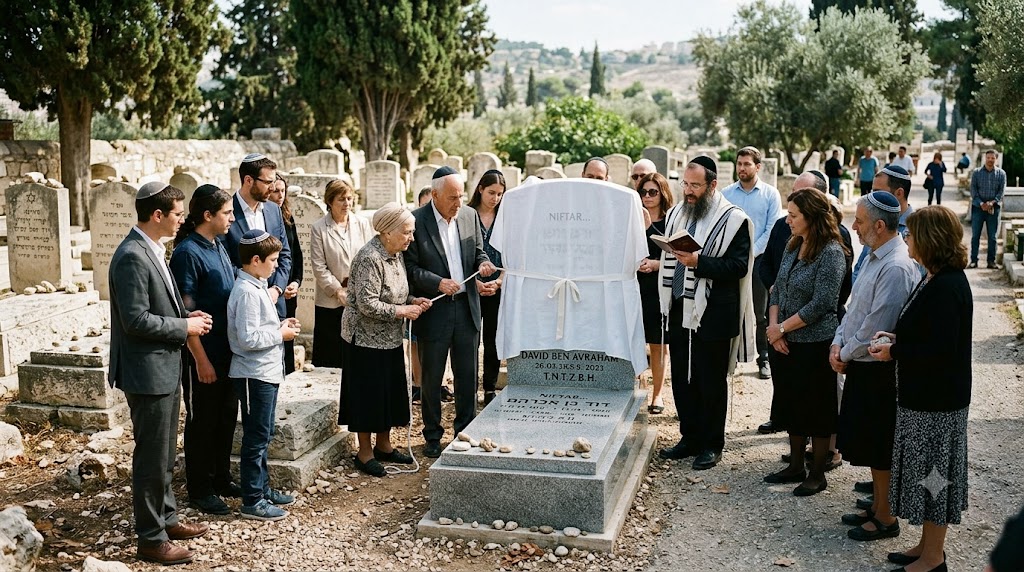
One detail that surprises some families: the physical headstone can be installed well before the unveiling ceremony itself. The ceremony is the formal, symbolic dedication, traditionally involving a cloth covering removed to reveal the inscription, but the stone doesn't need to sit uninstalled until that date arrives.
This matters practically because grave settling and production timelines don't always align neatly with the ceremony date a family has in mind. A stone can be produced, approved, and installed on the schedule the settling period and production timeline allow, with the unveiling ceremony scheduled separately once the family is ready, rather than trying to compress design, production, shipping, and installation into whatever window falls before a specific ceremony date.
What a Traditional Matzeivah Inscription Includes
Jewish tradition doesn't mandate a specific size or style of headstone, and most families follow whatever the specific cemetery's general rules require. Inscriptions, though, often follow recognizable conventions:
- The Hebrew letters פ"נ at the top, an abbreviation for "here lies"
- The deceased's Hebrew name, often including "child of" a parent's Hebrew name
- Dates in the Hebrew calendar, frequently alongside the standard Gregorian dates
- The closing Hebrew letters תנצב"ה, an abbreviation for a phrase meaning "may their soul be bound up in the bond of eternal life"
- The English name, dates, and any additional English inscription the family wants
Hebrew text, dates converted to the Hebrew calendar, and these traditional abbreviations should always be verified carefully before production, since errors here are both easy to make and difficult to catch without someone specifically checking Hebrew spelling and calendar conversion.
What the Ceremony Itself Involves
An unveiling is typically brief, often no more than thirty minutes, held graveside. A common structure includes a psalm or prayer, the removal of the cloth covering the stone, a recitation such as El Malei Rachamim, brief remarks or memories shared by family, the placing of small stones on the marker as is customary at any cemetery visit, and closing with the Mourner's Kaddish.
Unveilings are generally not held on Shabbat or major Jewish festivals, and families often work with a rabbi or cantor to arrange the specific date, though a family member can lead a simpler version of the ceremony as well.
A note for dealers and funeral homes: unveiling season tends to cluster in spring and fall in many communities, which means production and installation deadlines around those windows benefit from being confirmed further in advance than usual. A family targeting a specific unveiling date is working backward from a fixed point in a way that a typical headstone order isn't, so confirming the production and installation timeline against that date early, rather than assuming standard lead times will comfortably fit, avoids a scheduling conflict nobody wants to discover close to the date.
Next Step
If you're planning a monument with Hebrew inscription or working toward a specific unveiling date, our Request a Quote page is a direct way to confirm current production timelines against your target date.
Unveiling timing and ceremony customs vary by community, denomination, and individual family practice, and what's described here reflects common patterns rather than a single fixed standard. Families should confirm specific timing and ceremony details with their own rabbi rather than treating any single custom described here as universal.
Frequently Asked Questions
How long after death is a Jewish unveiling held?
Most commonly between eleven months and one year after death, timed around the first yahrzeit, though this varies by community. Some families hold it earlier, around three to six months, and Chabad tradition often erects the stone as soon as the day after shiva concludes.
Does the headstone need to be installed before the unveiling ceremony?
The stone can be installed before the unveiling; the ceremony is a separate, symbolic dedication and doesn't need to happen at the same time as physical installation. This gives more flexibility in scheduling around production and grave-settling timelines.
Is an unveiling required by Jewish law?
No. The unveiling ceremony itself is a modern custom, particularly common in American Jewish communities, and isn't prescribed by Jewish law. Marking a grave with a permanent monument is the older, more established tradition; the specific ceremony of unveiling it is a more recent practice.
What does a traditional Jewish headstone inscription include?
Many include the Hebrew letters פ"נ at the top, the deceased's Hebrew name, dates converted to the Hebrew calendar, and the closing letters תנצב"ה, alongside the English name and dates most families also want included. Cemetery rules and family preference both shape the final design.
Who leads an unveiling ceremony?
Many families invite a rabbi or cantor, though a family member can lead a simpler version using traditional psalms and prayers. It's worth arranging the date several weeks or months in advance, since demand for rabbis around common unveiling seasons can be high.
Ready to get pricing for your granite monument?
Request pricing, factory specifications, and DAP delivery timelines from our team.