Granite Factory Offcuts: Reuse Beyond the Memorial
Granite factory offcuts can have useful second lives, but offcuts, crushed fragments and processing sludge are different materials.
By Marwaa Team · Editorial standards · Published · Updated

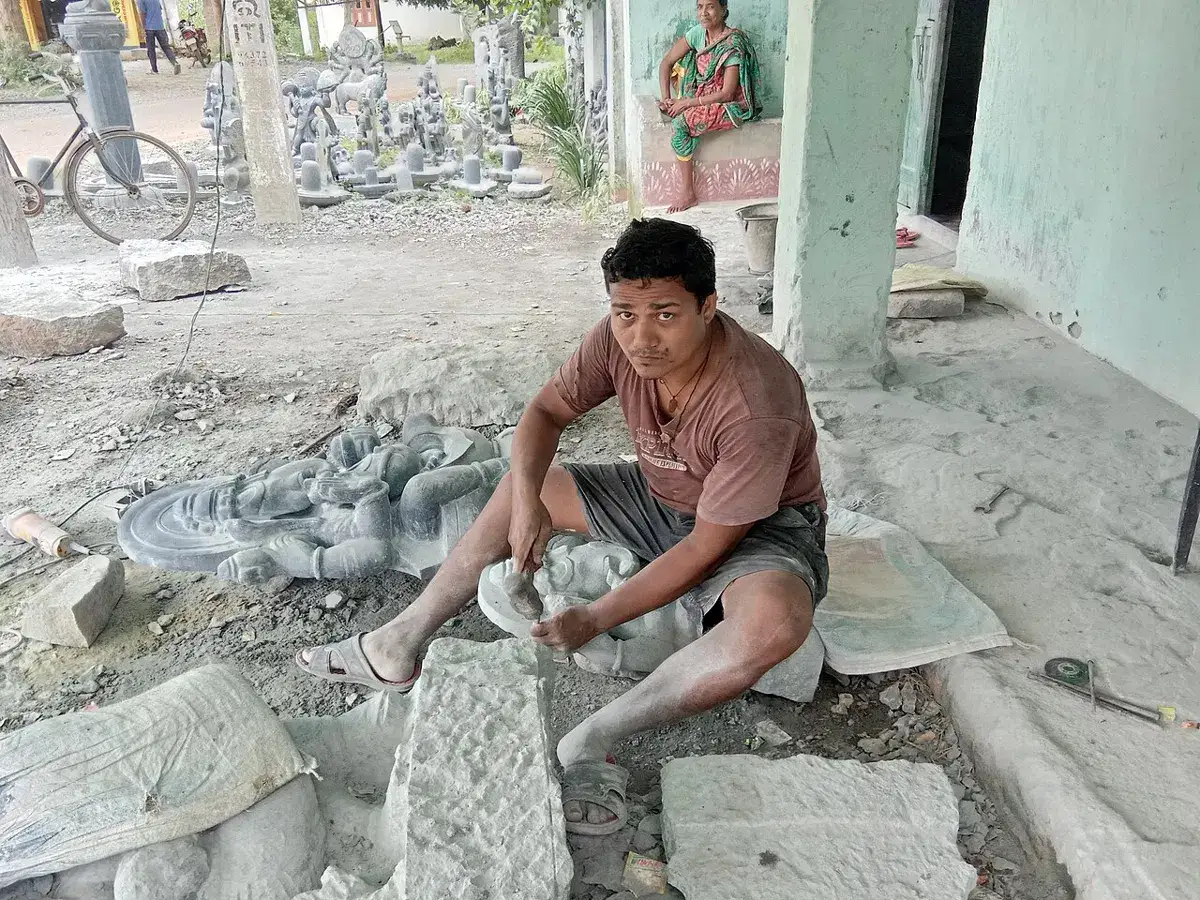
Illustrative stock photograph: HK 柴灣 Chai Wan 哥連臣角道 Cape Collinson Road stone workshop rain May 2013.JPG by Feastilwloa · CC BY-SA 3.0. Resized and converted to WebP. The photograph does not represent Marwaa’s work or a featured service location.
Granite factory offcuts can have useful second lives, but offcuts, crushed fragments and processing sludge are different materials. A sound piece may suit another stone product; smaller material may need processing and testing for another use. Reuse depends on size, condition, contamination and the receiving application. Do not count every leftover piece as a usable memorial or describe all stone waste as automatically harmless.
What are granite factory offcuts?
An offcut is a piece left after a larger shape is cut from stone. It may have enough sound material for a smaller product. Other leftovers are small fragments, fine particles or sludge from wet processing. Treating all of these as one waste stream hides their different possibilities.
A review of dimension-stone waste reuse discusses several forms and possible applications. Research into an application does not establish that every factory's leftover material meets its requirements.
The practical first step is to identify what is available. A stockpile of mixed pieces with unknown history is harder to use than separated material with known source and condition. Good information can matter as much as the stone's original sales value.
Why a sound offcut is not automatically a product
A piece needs usable geometry. A long narrow strip may have plenty of mass but little room for the proposed shape. Sawing losses and later finishing still apply. The smallest outside dimensions do not describe the whole usable volume.
Condition also matters. A natural feature acceptable in a rough landscape piece may be unsuitable beside a fine inscription. An offcut must meet the new product's needs in its own right. It should not receive weaker acceptance merely because it came from leftover stock.
Pattern can limit use too. A directional stone may not suit rotation. A small accessory may look different from the main monument even when both came from the same material group. Reuse is useful only when the final piece works as intended.
Keep product reuse separate from crushing
Using a sound piece as another stone item preserves a different form of value from crushing it for aggregate. Both may be possible routes, but they involve different processing, transport and market requirements.
Aggregate use needs suitability for the receiving purpose. Grading, material properties and any relevant contaminants may matter. Do not send mixed waste to a construction application on the assumption that any hard stone will do.
Fine sludge is different again. It can contain process residues and requires its own assessment. A finding that a particular waste worked in one research mixture is not permission to use all slurry in the same way.
Factory process-water recycling is a separate practice from reusing solid offcuts and needs its own stated scope. See Stone Workshop Water Recycling: What Buyers Can Ask.
What should a buyer ask about reuse claims?
Ask which waste stream the supplier means and what actually happens to it. Reuse, recycling, recovery and storage should not be treated as interchangeable descriptions. Material left in a yard has not necessarily been reused.
Be careful with percentages. A claim needs a stated period, material boundary and measurement basis. Weight recovered is not the same as the number of products made from offcuts. A clear limited account is more useful than a large unsupported figure.
A bulk order discussion can identify whether dimensions or a compatible order mix allow sensible material use. Cemetery limits, design and product quality still take priority. Do not change a required dimension just to create a better waste claim.
Avoid a simple environmental ranking
Reusing local offcuts can reduce demand for new material in a specific use. It can also require transport, cutting and finishing. A whole environmental comparison needs a defined boundary and evidence, not only a photograph of a leftover piece.
This does not make reuse pointless. It makes the claim more precise. Explain what material was used, where it went and which new purchase it replaced, if that is known. Where the outcome is uncertain, say so.
Granite offcuts deserve practical attention because stone is valuable and processing takes effort. The strongest approach starts with identified material and a suitable receiving use. It avoids treating waste as either worthless by default or a finished sustainable product before the necessary work is done.
Compare the decisions
| Area | What to establish | Why it matters |
|---|---|---|
| Sound offcut | Size, condition and usable shape | Judge it against the new product |
| Fragments | A suitable processed application | Hardness alone does not establish acceptance |
| Fine waste | Its contents and handling route | Do not assume sludge equals clean aggregate |
Key Takeaways
- Size, condition and usable shape. Judge it against the new product.
- A suitable processed application. Hardness alone does not establish acceptance.
- Its contents and handling route. Do not assume sludge equals clean aggregate.
Frequently Asked Questions
Can every offcut become a small memorial?
No. Shape, condition, pattern and required finishing can prevent that use.
Is storing leftover stone the same as recycling it?
No. A reuse or recycling claim should identify an actual route and outcome.
Does a research application approve all granite waste?
No. Material and receiving-use requirements differ. The actual waste stream needs assessment.
Discuss the trade requirement
For a bulk memorial project, send the intended material, design and use to Marwaa. Ask for a clear response to the questions that affect your order before approving production.
Read More
- Can You Reuse or Recycle an Old Headstone?
- How Are Headstones Made? From Quarry Block to Cemetery
- Where Does Headstone Granite Come From?
A Note on This Guide
This concerns factory leftovers, not permission to remove or repurpose an owned cemetery memorial. It claims no measured environmental saving for Marwaa. This is general educational guidance for dealers and other buyers. The people responsible for the project should resolve material, cemetery and technical requirements for the actual order.
Published by Marwaa Team for Marwaa Memorials (marwaamemorials.com) · Published 2026-11-23 · Updated 2026-11-23 Marwaa Memorials is a factory-direct exporter of bulk granite monuments and headstones, shipping to monument dealers, funeral homes, and importers across North America.
Related guides
Local or Factory Monument Engraving: A Dealer Decision
Can You Reuse or Recycle an Old Headstone?

Headstone Ideas for a Factory Worker

DAP Granite Monument Delivery Explained: Factory-Direct Shipping to Canada and the USA [2026]

Accessible Monument Catalogues: Beyond an Image-Only PDF